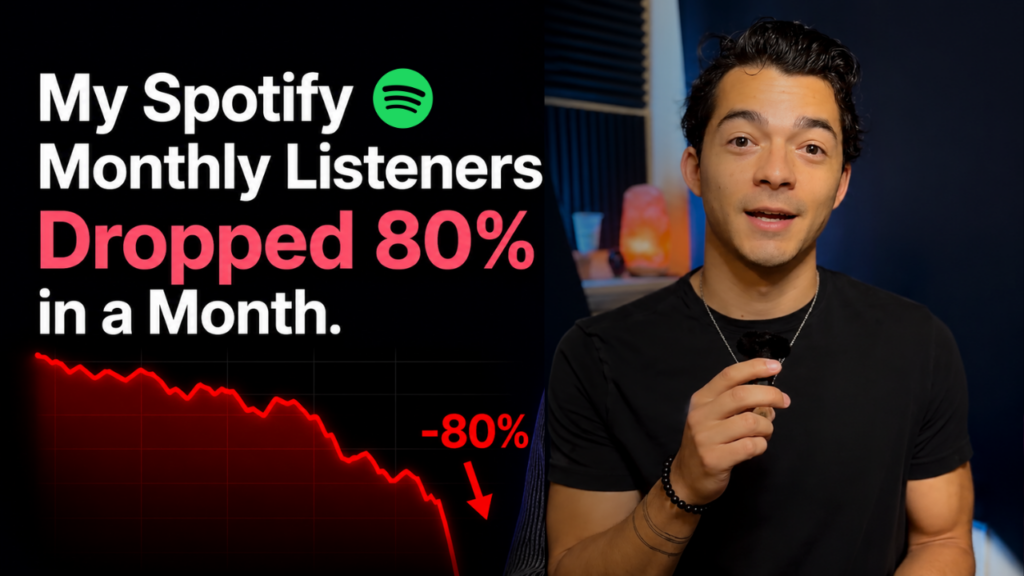
There’s no straight line to success. Every path has ebbs and flows, and all you can really do is ride the wave and try to build enough momentum behind you that you eventually cruise instead of paddling the whole time. I’m opening with that because I’m about to show you a number that looks like a disaster: my Spotify monthly listeners dropped 80% in the last 28 days. Not a typo. Eighty percent.
I’m not writing this to complain about it. Most artists panic the second they see a number like this, and the advice they find is generic, four bullet points that could apply to anyone. This is the real version. What actually caused the drop, what a $1,000-a-month growth agency taught me that I didn’t expect, and the three things I’m testing right now to turn it around.
The Numbers, Straight, No Spin
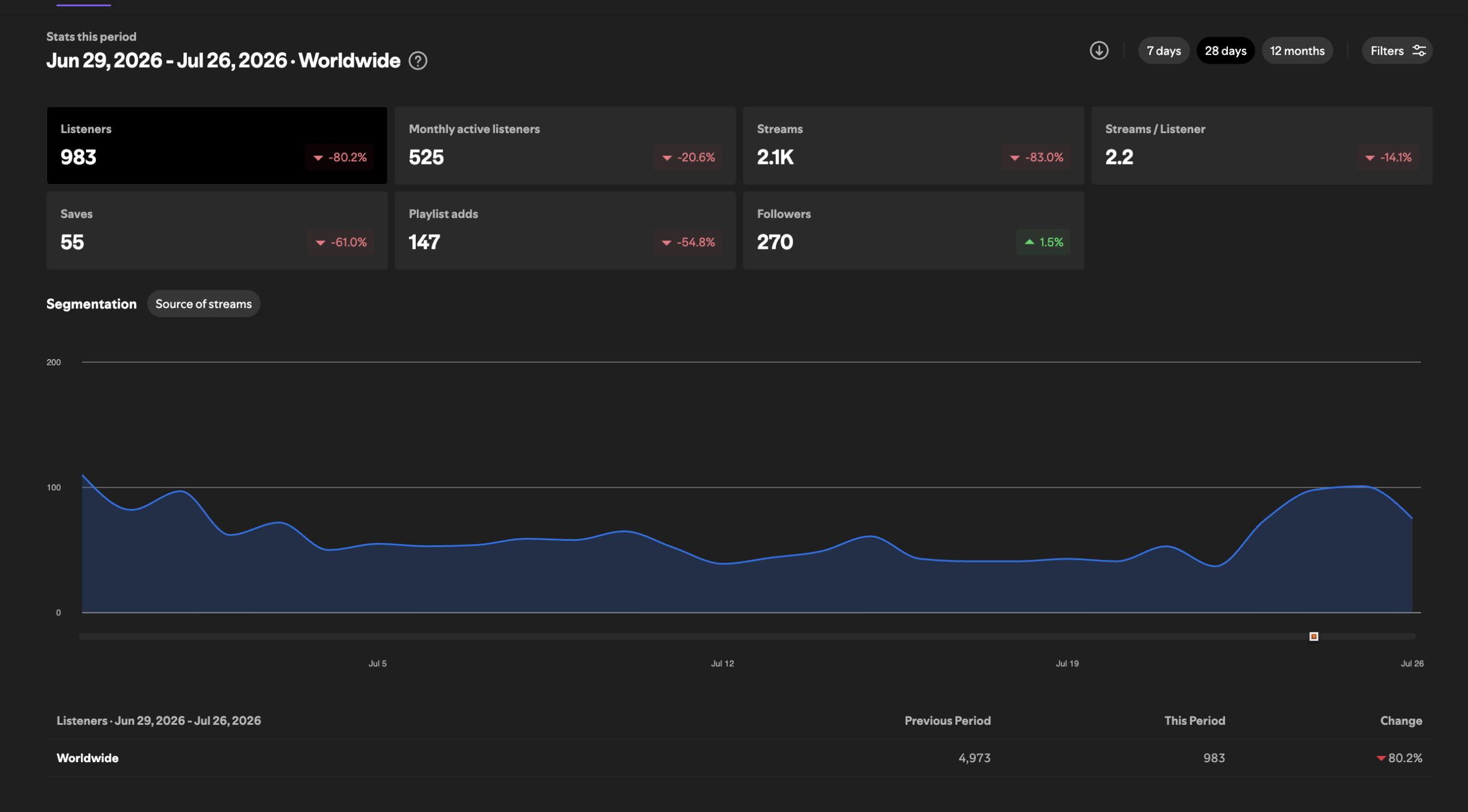
Here’s the screenshot, no cropping, no cherry-picked window. In the 28 days from June 29 to July 26, Spotify for Artists shows 983 monthly listeners, down 80.2% from 4,973 the period before. Streams dropped 83% to 2.1K. Saves fell 61%, playlist adds fell 55%. The only number that moved up was followers, a small 1.5% gain to 270. That’s the kind of sudden loss of Spotify listeners other independent artists describe hitting without ever seeing the full picture behind it.
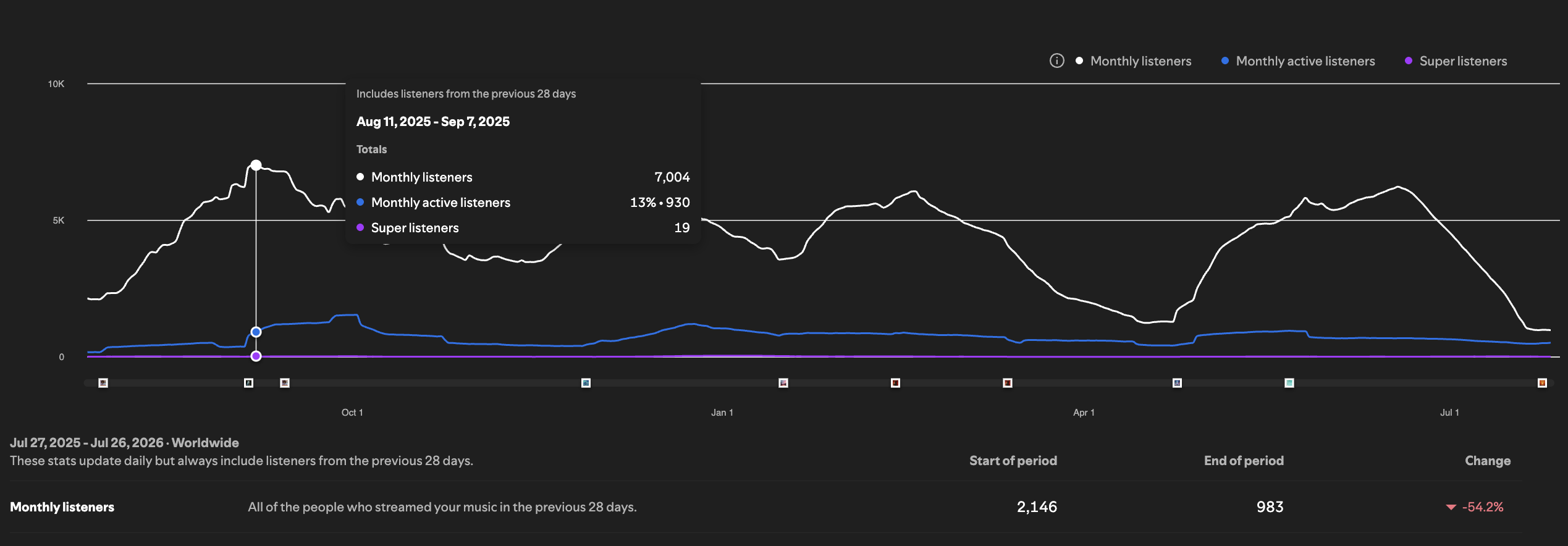
Now zoom out to the full year, and this is where it actually gets interesting instead of just bad. Plotted week by week since last July, my monthly listeners climbed to a peak of 7,004 in early September, dropped back down, climbed to another peak near 7,000 again in early July, and are now crashing toward the 983 you just saw. Comparing the start of that window to the end, listeners are down 54.2%. But the chart itself tells the real story better than any single number: this is the second time this year I’ve hit a peak and watched it collapse.
What Actually Caused My Spotify Monthly Listeners to Drop?
It’s not one thing. I lost my growth agency, Josbon Media, at the end of June after paying them $1,000 a month for a while. Some playlist placements dropped off around the same time, and I noticed shifts in how the algorithm was treating my catalog that I can’t fully explain.
But if I’m honest, the biggest cause wasn’t any of that. It was me. My last release before this drop was “Playfriend,” a remix with Sam Shardex, on May 22. I didn’t put out anything else until “Summer Dayyzz” on July 24, exactly two months later. That gap is the real answer.
This tracks with what’s actually recommended right now. The waterfall release strategy that’s become the standard 2026 playbook calls for a new single every four to six weeks, specifically because algorithms reward consistent releases more than one big drop and go quiet again. I went twice that long with silence, and staying quiet for too long is one of the most common reasons monthly listeners fall in the first place. Other artists describe the exact same pattern once their release calendar goes quiet, the listener count follows it down not long after.
The Real Lesson From a $1,000-a-Month Growth Agency
Here’s the part that surprised me most, and it’s not what you’d expect from someone whose numbers just fell off a cliff. Josbon Media delivered real results. The playlist ads they ran genuinely pushed my stream count up, and I don’t regret paying for it.
The problem wasn’t their execution. It’s that playlist streams don’t build fans. They build a temporary spike in a number that disappears the moment the placement ends, because nobody who found me through a playlist actually followed me, saved a track, or came back for the next release. Fans come from direct relationship-building, the thing social media is actually built for and that most artists, myself included, treat as an afterthought next to the number itself.
The best thing I got out of that $1,000 a month wasn’t the streams. It was watching how they built pitch strategy and curator relationships closely enough that I realized I could do most of it myself. That’s the actual return on a growth agency for an artist at my stage. Not the growth itself. The education behind it.
What Happens When You Stop Feeding Spotify Algorithm Momentum?
Look at that chart again. The first time I hit 7,004 monthly listeners, back in September, I assumed that was a floor. I figured growth from there would basically take care of itself, that momentum, once you have it, just keeps compounding on its own. It didn’t. It dropped, climbed back to almost the exact same peak in July, and dropped again, harder this time.
That’s not a fluke. Momentum has to be fed constantly or it collapses, and an 80% drop in 28 days is what that collapse looks like in real numbers, twice now in one year. There’s no straight line to success. Every path has ebbs and flows, and the only real skill is learning to ride the wave, building enough momentum behind you that you can eventually cruise instead of constantly paddling just to stay in place.
What I’m Testing to Recover My Spotify Monthly Listeners
Here’s what I’m actually doing, starting with the July 24 release of “Summer Dayyzz.” I’m running my own ads instead of paying an agency to run them. I’m pushing pre-saves hard in the weeks before release instead of treating them as an afterthought. And I’m submitting to curators directly, then actually following up and building the relationship instead of a one-time pitch and forget.
None of this is complicated, and the artists actually growing right now aren’t just releasing more, they’re running a sustained system instead of a one-time drop, which is the whole point of doing all three at once instead of picking one. If you want to see how it’s actually landing, go stream “Summer Dayyzz” right now. That’s the real, live test this whole post is about, and it’s still running as you read this.
What Would I Tell Another Artist Watching Their Numbers Crater?
If you’re watching your own numbers fall right now, here’s what I’d actually tell you, not the polished version. Don’t build your income on streams. I’m not living off Spotify right now. I’m working part-time at Starbucks, playing DJ gigs, and doing content work for other music brands, and juggling all of that while trying to keep my own release schedule alive is genuinely hard some weeks. That’s the same lesson I wrote about in the real climb to a $5K month as an online producer coach: the number on Spotify was never supposed to be the whole plan, and a million streams alone still leaves plenty of artists broke.
What actually works is staying consistent, working on your craft instead of chasing a number, and collaborating with other artists whenever you get the chance. The Sam Shardex remix that came out right before this drop is proof of that specific point. It gave me access to an audience that already trusted someone else’s judgment, which is worth more than almost any ad spend, and it’s the same push behind how I built momentum hitting 1.4 million views in 90 days: find the people who already have an audience that trusts them, and let that trust do work yours can’t do alone.
I’d genuinely like to know what’s actually working for you right now. If you’ve found something moving your numbers in 2026 that isn’t in the standard playbook, tell me. I’m testing this in public, and I’d rather learn from what’s actually working for you than pretend I’ve got this fully figured out. It wouldn’t be the first time I’ve had to talk myself through a rough patch and come out the other side of it anyway.
The Honest Summary
My Spotify monthly listeners dropped 80% mostly because I went quiet for two months, a paid agency taught me more than it grew me, and momentum only holds if you keep feeding it. None of that is unique to me. It’s just rarely said out loud with the real numbers attached to it.
Right now I’m running the same playbook Josbon Media ran, just myself, starting with “Summer Dayyzz.” If any of this maps onto a release or growth problem you’re sitting with, and you want a second set of eyes on it, that’s exactly what a free strategy call is for. No pitch, just a real look at what’s going on. Book one here if it’d help.
Frequently Asked Questions
- Why did my Spotify monthly listeners drop suddenly?
-
It’s rarely one cause. Losing playlist placements, algorithm shifts, and pausing paid promotion all play a role, but the most common driver is a gap between releases. Spotify’s monthly listener count is a rolling 28-day figure, so going quiet for two months or more will show up as a steep drop even if your older tracks are still solid.
- How often should independent artists release music to keep algorithm momentum?
-
Current guidance points to a new single every four to six weeks, sometimes called a waterfall release strategy. This keeps Release Radar active and gives the algorithm repeated evaluation windows, instead of one big drop followed by silence.
- Do playlist placements from a growth agency build lasting fans?
-
Not usually. Playlist streams boost your numbers while the placement is active, but most of those listeners never follow you, save a track, or come back for your next release. Lasting fans come from direct relationship-building, which is a different effort than paid placement.
- Is it normal for Spotify monthly listeners to go up and down?
-
Yes, more than most artists expect. A full year of data can show multiple peaks and drops rather than one steady climb. Hitting a high number once doesn’t mean it holds. It has to be actively maintained through releases and promotion, or it comes back down.
Pingback: Meta Andromeda for Musicians: What I Learned at the Invite-Only Agency Summit