Meta’s Agency Summit is invite-only. It’s for the people who run ad accounts for a living, and the invite came my way because of the work Cylus Music does running Meta ads for artists and music brands. This year’s North America session ran virtually on September 16, and I watched it from my desk. The lineup was Meta’s own: Erik Hawkins, Vice President of Global Partners, ran the main Q&A; Simon Whitcombe, Vice President of Meta’s Global Business Group, closed it out; and Mat Micheli, Co-Founder and Co-CEO of Viral Nation, was there for the agency side.
The moment that stuck came in Erik’s Q&A with Sukhesh Miryala, one of the product leaders behind Meta’s ad system. Sukhesh said that when a big client tells him their ads aren’t working, he doesn’t open the campaign. He says, “let me look at your signal.”
What I heard was a simpler question: who are you pointing this at? In music, that’s one of two groups. Other producers, if you’re selling a course or a service. Or the people who’d actually listen to the song. Those are different campaigns, and most of what goes wrong with Meta ads for musicians starts with not deciding.
Here’s what the summit said changed inside Meta’s machine, what Meta told the agencies to do, the part I don’t buy, and what I’ve seen get artists streams. The last time I wrote up an industry event it was about gear. This one is about where your ad money goes.
What Meta Andromeda Actually Does
Every time someone opens Instagram, Meta has a split second to choose a few ads out of millions. The first step is a rough cut, and Meta Andromeda is the program that makes it. Meta’s engineers say the model behind that cut is 10,000 times more complex than the one it replaced. Sukhesh’s version was shorter: the system now looks at far more ads before it picks one for you.
Here’s the part that matters. Andromeda looks at the ad itself, the video and the words on it, to guess who’d respond. The interests you tick in Ads Manager are a hint. The ad is the instruction.
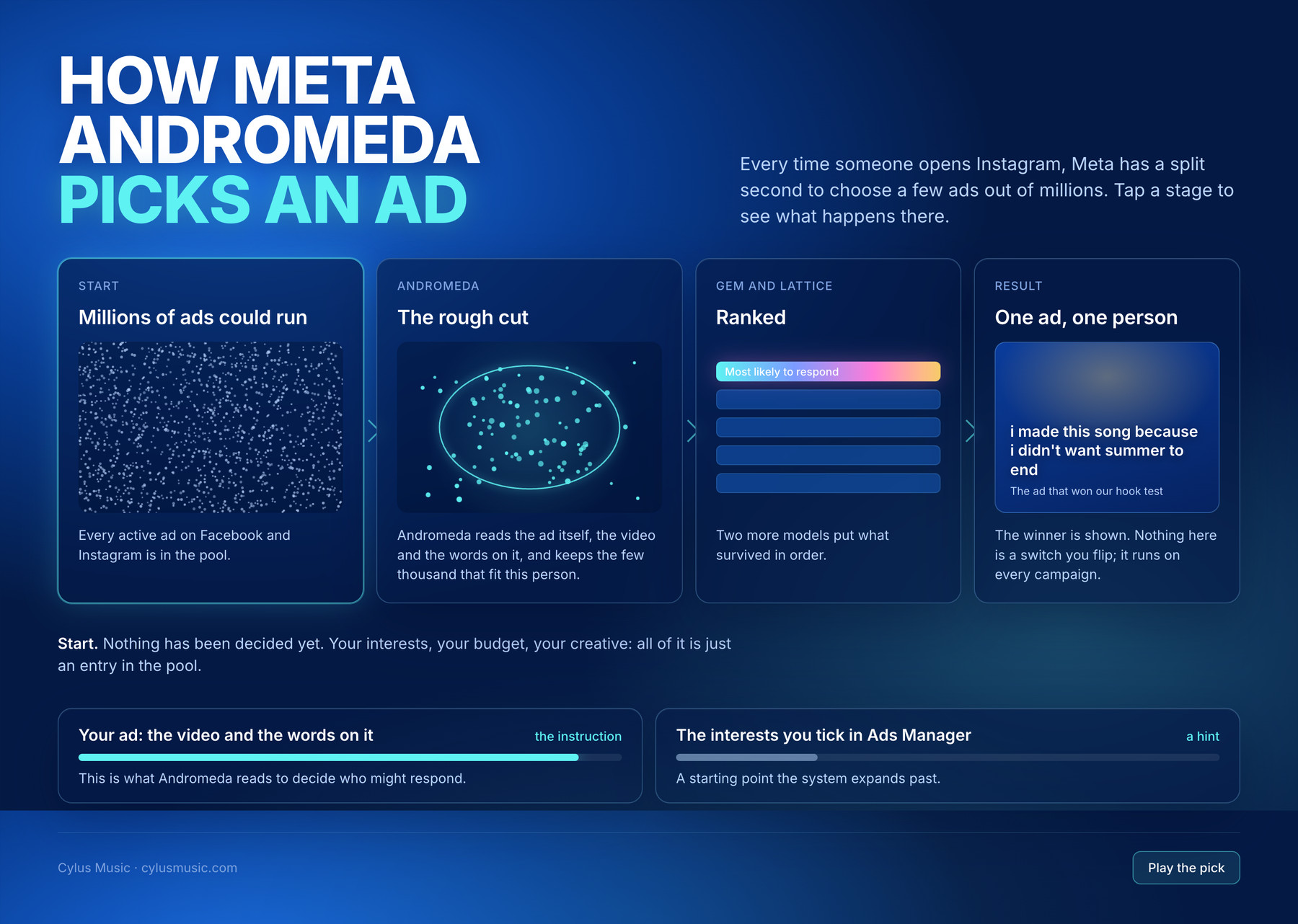
Two other models came up, GEM and Lattice, and all you need to know is that they rank whatever survives the cut, and they’re already running on every campaign you own. Nothing to switch on.
What Meta Told the Agencies to Do
Four things, and Sukhesh admitted he was repeating himself on the second one.
Spend the most when people are most ready to act. For a store that’s Black Friday. For an artist it’s release week, not a trickle spread over two months. Tell the system what you value, because it only understands what you ask it to go get, and if you ask for clicks it will find you the cheapest clicks on earth. Leave it alone once it’s running; every change to the budget, the audience or the ad sends Meta back to relearning who to show it to. And measure outside Meta. More on that in a minute.
He also mentioned something I’ve already put to work: since April, Meta lets AI assistants like Claude and ChatGPT read and manage your ad account. Every Meta number in this post came out of a chat window.
The part I don’t buy
Meta’s answer to most of this is Advantage+, its bundle of automatic settings where the machine picks the audience, the placements, and sometimes the creative for you. This is where I see musicians get it wrong most often. Advantage+ was built with stores in mind: a catalog of products, a shopping cart, a purchase it can count. A song has none of those. Hand it a music ad and it optimizes for whatever it can measure, and in my experience that usually doesn’t go well. The line of the day was “give the AI room to act.” For music, I’d be careful how much.
Conversion Lift: The Test Everyone Kept Asking About
Conversion Lift is Meta’s test for whether an ad actually caused anything, and it came up over and over. In plain words: Meta hides your ad from a random slice of the people it would have shown it to, then counts how many people in each group did the thing you wanted. The difference is the lift, what the ad caused, not what it happened to be standing next to. Meta shared that giving all the credit to the last click had been undercounting purchases by about 15%, and it’s now folding what it learned from thousands of these tests into everyday reporting.
If you run paid media, this is the number you’ve always wanted. It answers the one question every client asks: would this have happened anyway? And it changes the sentence you get to say to an artist. “Your budget caused saves that wouldn’t have happened” is a different sentence from “you got a lot of clicks.”
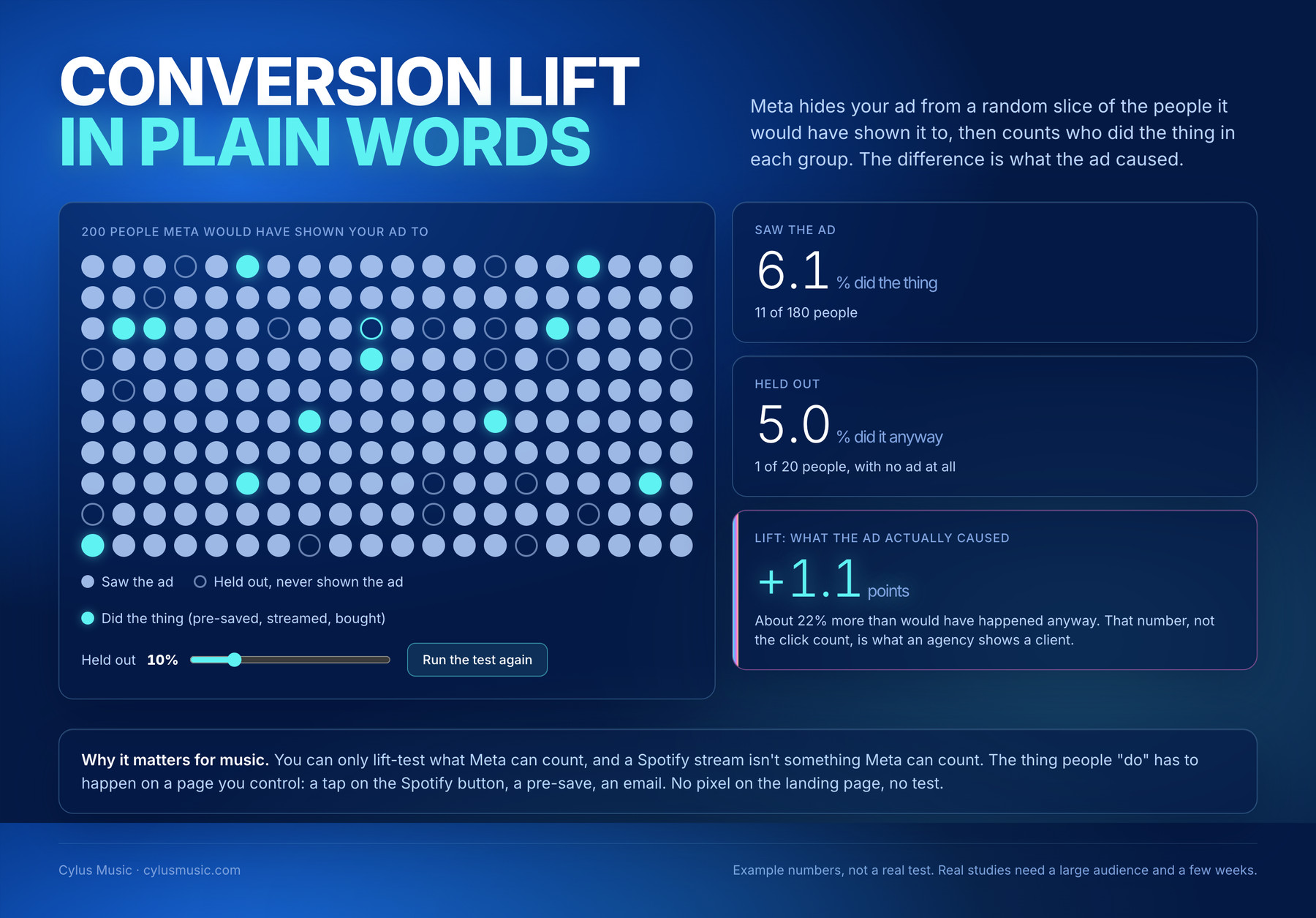
For those of us in music growth marketing, there’s a catch. You can only lift-test what Meta can count, and a Spotify stream isn’t something Meta can count. The conversion has to happen on a page you control: a tap on the Spotify button, a pre-save, an email. No pixel on the landing page, no test. The full study also needs a big audience and a few weeks, which fits a label roster better than a single release. For artists who aren’t at that scale, the version that works is a country holdout: same ad in one of two similar countries, not the other, then compare streams by country in Spotify for Artists two weeks later. One of my own campaigns taught me that by accident.
The Campaign That Taught Me to Stop Trusting Ads Manager
This summer I ran ads for my single Summer Dayyzz and changed what I was asking Meta for three times: page loads, then link clicks, then real conversions once the landing page could report them. Every version did the same thing. It went looking for the cheapest copy of what I asked for and found it in Mexico, Brazil, South Africa, Malaysia and Turkey. Those five countries took 89% of the clicks. Mexico alone sent 1,395 people to the link. Ads Manager looked great.
Six days after release I opened streams by country. United States 192, France 14, Belgium 12, Germany 10, Italy 9, Canada 7, Poland 7. Brazil 2. Mexico, Malaysia, South Africa and Turkey weren’t on the list. The song was getting streams. They just weren’t coming from where the ads went.
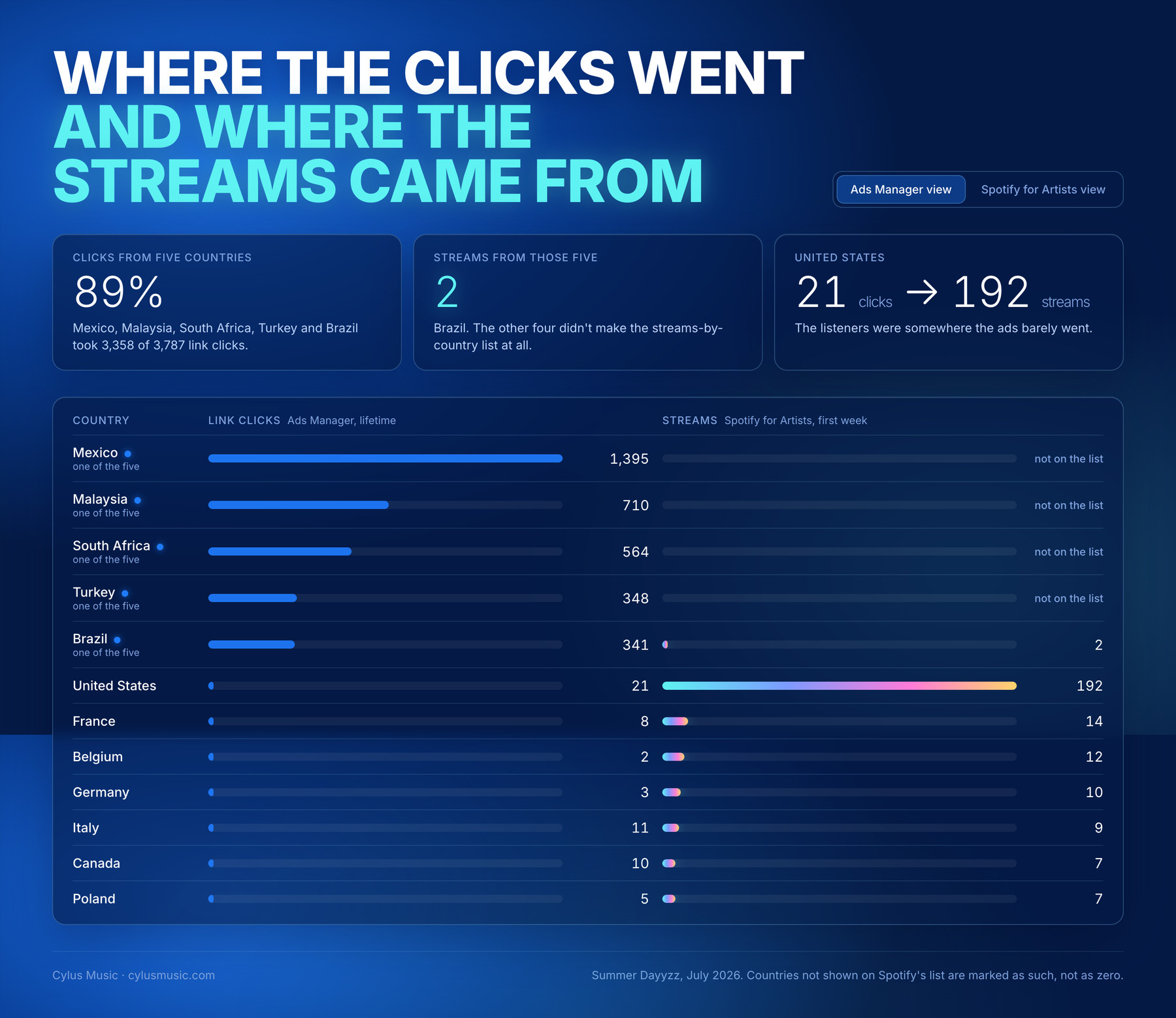
That was a signal problem in Sukhesh’s sense. The pre-save page had no pixel on it, the small piece of code that tells Meta when someone on your page actually did something. Meta could see the click and nothing after it. I told it what I valued in the only language it reads, and it delivered exactly that. The full breakdown across five campaigns is here.
Does Meta Andromeda Make Targeting Pointless for Musicians?
Meta’s answer is mostly yes. The Confect guide to Andromeda says the main way Meta picks who sees an ad has moved from the audience you choose to matching the ad itself to people. My answer, after running a lot of these for music, is not yet.
Look at what has worked. My best-performing campaign, On My Love, pulled a 13.9% click rate. The only Summer Dayyzz ad set that produced pre-saves was the one I built by hand, pointed at the countries where the listeners already were. Its clicks cost more than ten times what the cheap versions paid, and they were the only ones that turned into anything.

The winners had three things in common. Targeting I picked myself: countries where the listeners already are, not wherever the click is cheapest. A song with lyrics; songs with lyrics tend to perform better in ads, at least in everything I’ve run. And a creative that wasn’t complicated. A simple royalty-free clip, the song underneath, the lyrics on screen. That gets results. You don’t need a visualizer that costs more than the campaign.
The Click Is Not the Stream
Here’s the thing I’d be lying to skip. Running ads on a song does not automatically turn into streams. Getting someone off Instagram and into Spotify is real friction: leave the app, land on a page, tap a button, open another app. Most of the money leaks in that gap.
So before the next release, get the landing page right. A button for Spotify, Apple Music and YouTube Music, the three most popular platforms, with the one you’re optimizing for first. A pixel on the page, so Meta can see what happened and so you can show the next ad to the people who already clicked. And no email gate before they can hear the song. Nobody trades an email for a stream. Unless you’re giving away something big, keep the gate off.
Then pick the audience yourself, keep the ad simple, and judge it in Spotify for Artists, not Ads Manager.
What I’m Taking Back to Our Clients
The ad system did change. Meta Andromeda makes the first cut, and the ad itself is now the main thing telling the machine who to find. What didn’t change is that the machine was built for stores, and a song isn’t a product with a cart. The job that’s still ours is deciding who the song is for and giving them the shortest path to press play.
Erik Hawkins said something near the end that I’ve been repeating since: the gap in our industry isn’t capability, it’s readiness. The tools are there. The question is who’s ready to use them properly. Simon Whitcombe put it from Meta’s side: when we build, we build for you, because when you win, we win.
That’s the work Cylus Music does for artists and music brands: the targeting, the creative, the landing page, and the measurement that tells you what the ad actually caused. If you’ve got a release or a launch coming and want it run properly, book a call. Bring your landing page.
Frequently Asked Questions
- What is Meta Andromeda?
-
Andromeda is the part of Meta’s ad system that makes the first rough cut: out of millions of ads, it picks the few thousand that even get a chance to be shown to a person. It reads the ad itself, the video and the words on it, so the ad now does most of the work that picking interests used to do.
- Does Advantage+ work for music ads?
-
In my experience, not well. Advantage+ was built for stores with a catalog and a purchase it can count. A song has neither, so it optimizes for whatever it can measure, usually the cheapest click. Picking the countries and audience yourself has worked better for me.
- What should a music ad landing page have?
-
A button for Spotify, Apple Music and YouTube Music, with the platform you’re optimizing for first, and a pixel on the page so Meta can see what people did and you can show the next ad to people who already clicked. Skip the email gate unless you’re giving away something big.
- How do I know if my music ads actually worked?
-
Judge the campaign in Spotify for Artists, by streams and saves by country, not in Ads Manager. Ads Manager reports on the action you asked for; Spotify reports on whether anyone listened.