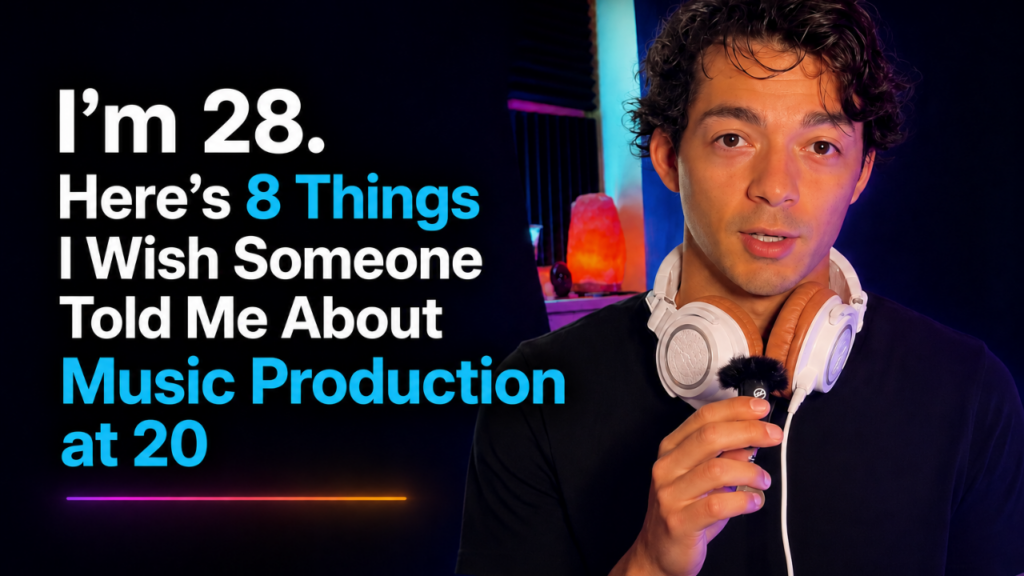
I turned 28 this year. Ten years into producing, which means ten years of figuring out how to learn music production mostly by trial, mostly alone, and slower than it needed to be.
If I could sit my 20 year old self down for twenty minutes, here’s exactly what I’d tell him. Not gear lists. Not plugin recommendations. The stuff that would have moved the needle, the kind of thing nobody hands you at the start.
Here are the 8 things, roughly in the order I wish I’d heard them.

Start Documenting What You’re Making From Day One
When I first started, I was just trying to work with anyone, any project that would have me. I don’t regret that part. It broadened my skills and kept my mind open in a way that specializing early wouldn’t have.
What I regret is staying quiet about it.
I was making some genuinely good beats in those early years. Tracks I’d still stand behind today. And instead of putting them anywhere people could hear them and react, I sat on them. Five to six years passed before I started sharing consistently online.
Five to six years is a long runway to give up for free. That’s what the silence cost me: feedback I never got, and an audience that could have been building the whole time I was deciding whether the work was good enough to show anyone.
Documenting means posting the rough cut, the half-finished loop, the thing you made this afternoon, not a polished highlight reel. It’s proof, to yourself as much as anyone else, that you’re doing the work.
There’s a practical reason it matters, too. A comment on a rough loop tells you something’s off with the low end before you’ve spent three more weeks building on top of it. Silence doesn’t tell you anything. I found out what worked and what didn’t only after the fact, one album’s worth of mistakes at a time, instead of catching them in real time from people who were already listening.
Nobody’s Listening Yet, and That’s a Gift
Right now, almost no one is watching. That should feel like pressure. It’s freedom instead. Nobody’s listening yet, which means you can experiment, release something rough, and get it wrong in public without any real cost.
I wrote a full breakdown of why this stage is the best one you’ll get in Music Production Tips for Beginners: What I Wish I’d Known at 20. Short version: use the obscurity while you have it. It doesn’t last.
Your Job Isn’t to Find Your Sound, It’s to Finish Tracks
A lot of producers think they need to lock in a signature sound before they’re allowed to start. That belief kills more momentum than any technical mistake does. It also takes the exploration, and the fun, out of the process before it’s even begun.
Your sound isn’t something you find by thinking about it. It’s something that shows up after you’ve finished enough tracks that a pattern becomes obvious. I go deeper on this exact point in Music Production Tips for Beginners. Finish the track in front of you. The sound follows.

Being Obsessed Is Normal. Quitting Is Common
Everyone starts obsessed. The first few months, you can’t stop opening the DAW. That part isn’t rare. Almost every producer I talk to on a discovery call describes the same early stretch: staying up too late on a track that wasn’t going anywhere, just because it felt good to be inside it.
What’s rare is staying obsessed once it stops being exciting. Once the honeymoon wears off and it’s just work: fixing the same arrangement problem for the third week in a row, redoing a mix because the reference track exposed how far off you were. That’s the point most people quit. Not because they ran out of talent. Because they ran out of the feeling that made it fun in the first place.
Most producers who quit don’t have a talent problem either. They have a confidence problem dressed up as burnout. Finishing a track means releasing it, and releasing it means someone might not like it. Staying in the obsessed, exploratory phase forever feels safer, because nothing you make in that phase has to survive contact with an audience.
I almost did the same thing. I wrote the whole story here. The producers who make it aren’t the most talented ones in the room. They’re the ones who stayed after the excitement left.
Stop Asking If It’s Good Enough. Ask If It’s Finished
Wrong question, every time. “Good enough” has no finish line. You can ask it forever and never get a clean answer, because the bar keeps moving the better you get.
“Finished” is a different question. Finished means nothing is broken, the arrangement holds together, and you’re not fixing things that don’t need fixing anymore. Perfection is just procrastination wearing a nicer outfit. Ship the track.
Progress Feels Boring When You’re Doing It Right
Nobody warns you that the correct version of getting better looks boring from the inside. Daily reps. The same fundamentals, practiced again, on a project nobody’s going to hear. No breakthrough moment, no montage. Just quiet repetition that doesn’t feel like anything is happening.
That’s exactly why most people never get there. Boring doesn’t feel like progress, so they go looking for something that feels more productive: another tutorial, another plugin demo, another hour watching someone else make music instead of making their own. Watching feels like learning. It isn’t the same thing as doing, and the two get confused constantly. I wrote about why that loop keeps producers stuck in Why YouTube Tutorials Are Making You a Worse Music Producer.
There’s more free production education online right now than any one person could get through in a lifetime. That was never the problem. Structure was. Knowing what compression does and being able to hear when your own kick needs it are two different skills, and only one of them comes from a video.
The reps are the whole job. They’re supposed to feel uneventful. Six months of uneventful reps is what separates a producer who’s actually improving from one who just feels like they are.
No One Is Judging You as Hard as You Think
Here’s the honest truth: the fear of being judged is doing more damage to your output than any actual judgment ever will. Most people scrolling past your post aren’t studying your mix or picking apart your arrangement. They’re thinking about their own day, their own project, their own version of the same fear that’s keeping you from hitting publish.
I see this constantly on discovery calls. Producers with finished tracks sitting untouched on a hard drive for months, bracing for a reaction that was never coming. The track doesn’t get worse by sitting there. It just gets more forgotten. Meanwhile the people they’re afraid of judging them are dealing with their own unreleased folder, their own version of the same hesitation.
Post the track. Upload the clip. Move on to the next one. The volume of work you put out matters more than any single reaction to it.
You’re Not Behind, But You Will Be If You Keep Hesitating
Right now, today, you’re not behind. Time only starts working against you the moment you choose to wait instead of start. Waiting feels safe. It’s the most expensive choice available to you, because the cost doesn’t show up immediately. It shows up two years from now, when you’re exactly where you are today, just older.
One of the fastest ways to close that gap: find someone a few steps ahead of you and learn from how they solved the problems you’re currently stuck on. I hear this on almost every discovery call I run, producers who wish they’d sought out mentorship earlier, before they spent months or years re-solving problems someone else had already worked out.
Rachel is a good example. She came into the 12-week program certain her mixing and mastering were the problem. A few sessions in, it turned out to be something else entirely: the kick and bass had been fighting each other for months, and no amount of EQ was ever going to fix that on its own. Before signing up, she’d weighed the program against a full academy in LA and picked the one-on-one format for the flexibility. With structured feedback, she finished the track. Her words after: “My kick and bass had a rivalry. Now they’re getting along.”
If you’re already producing consistently and just want a second set of ears on your mixes, you probably don’t need a mentor for that specific problem, a few targeted feedback sessions would do it. But if you’re stuck the way Rachel was stuck, or the way I was stuck for years before I found people ahead of me, that gap doesn’t close by waiting. I wrote more about the math on timing in Is It Too Late to Learn Music Production? and what a mentor does differently in What Are the Benefits of Having a Music Production Mentor?
What I’d Tell Him If He Were Standing Here
Eight years in, the thing that would have saved time isn’t a technique or a plugin. It’s starting sooner, finishing more, and dropping the wait for permission that was never going to arrive.
That’s the whole point of the 12-week coaching program I run now: compressing the years I spent figuring this out alone into a structure that gets you a finished, released track a lot faster than doing it solo. You’re capable of getting there on your own. You just don’t have to spend six years finding out what someone could tell you in twelve weeks.
If any of this sounds like where you’re at, book a free strategy call. Tell me what you’re working on and where you’re stuck. I’ll be straight with you about whether the program is the right fit or not.
Frequently Asked Questions
- How long does it actually take to learn music production?
-
There’s no universal number, but here’s mine: eight years to get where I am now, and most of the first few were spent producing without any structured feedback. Unstructured solo learning is the slow path, not the only path. Structured feedback compresses the timeline significantly.
- Do I need expensive gear to learn music production?
-
No. A laptop, a DAW, and a pair of closed-back headphones are enough to start. The gear conversation is usually a way to feel like you’re preparing instead of doing the work. Buy the next piece of gear when you hit a specific limitation, not before.
- Should I find my sound before I start making tracks?
-
No, and trying to is one of the most common ways producers stall out before they’ve made anything. Your sound shows up after you’ve finished enough tracks that a pattern becomes obvious, not before. Finish the track in front of you first.
- Is it normal to want to quit when you’re learning music production?
-
Yes. Everyone starts obsessed, and almost everyone hits a point where it stops being exciting and starts being work. That’s not a sign you picked the wrong thing. It’s the point where most people quit and the ones who stay start pulling ahead.
- How do I know when a track is actually finished?
-
Stop asking if it’s good enough, that question has no finish line. Ask if it’s finished instead: nothing is broken, the arrangement holds together, and you’re not tweaking things that don’t need it anymore. Ship it at that point.
- Do I need a mentor to learn music production, or can I teach myself?
-
You can teach yourself, and plenty of producers do. But self-taught learning has a longer feedback loop, you often don’t know what you’re doing wrong until much later. A mentor compresses that timeline because someone can look at your actual project and tell you directly what’s off. If you’re already releasing consistently, targeted feedback sessions matter more than ongoing mentorship.
- Is it too late to start learning music production at 25, 30, or later?
-
No. The only thing that makes you behind is waiting longer to start. Someone who begins at 30 and starts finishing tracks immediately will be further along in two years than someone who started at 20 and spent those two years hesitating.
- What’s the biggest mistake beginners make when learning music production?
-
Treating preparation as a substitute for starting: more gear, more tutorials, more research before the first track gets made. The producers who improve fastest are the ones who start making things immediately and let the specific problems tell them what to learn next.