At 7:45 on a Monday night last December, a label told me no. I’d sent a counter-offer three hours earlier and the reply was one line: “Sounds good and all, but we will decline that offer.” Nine minutes later they asked if I wanted my WAV files deleted.
I did. I’ve thought about that thread more than any release I’ve put out since, because it answers a question I get constantly: do you need a record label in 2026?
My answer is no, with one exception I’ll get to. Below: what a label has to offer right now, what one offered me, what my last release cost to do alone down to the dollar, and what to read in a contract before you sign it.
What Does a Record Label Actually Have in 2026?
Strip away the mythology and a label has one product: leverage. An audience they can push a song to on day one. Playlists they run, a DJ pool, a mailing list, artists on the roster who’ll share it. That’s the entire thing you’re buying, and it’s real. If you’re starting from nothing, a room full of listeners is not a small gift.
When giving up a split makes sense
I’ll say the part most “go independent” posts skip: sometimes it’s worth it. You have to start somewhere. If a label with a real audience wants half the revenue on one single in exchange for putting it in front of people who’d never find it otherwise, that trade can make sense. Doing this alone is a hard road, and I’m not going to pretend the first few thousand listeners come easy.
What they don’t have anymore
The rest of the product is gone. Distribution is a subscription now. Anyone with a Spotify for Artists account can pitch editorial playlists directly; you don’t need a label’s login. Cover art, a social kit, a press release: you can make all of it on a laptop in a weekend. The artist.tools explainer on the modern label puts it well: in 2026 a label should be an amplifier, not a gatekeeper. If a label’s pitch is built on the gatekeeper parts, the parts that stopped being scarce years ago, you’re paying for 2009.
The Record Label Deal I Turned Down
Rewind to 2:14 PM that same Monday. A small electronic label had heard “Paradise” and sent over an onboarding link with three PDFs attached: a masters agreement, a publishing agreement, and a services deck. Send us your IPI number and your PRO, sign the contracts, and we’ll schedule the release.
What was on the table
The masters deal was an exclusive, perpetual assignment at a 50/50 split. Perpetual means forever. The publishing deal was separate and sitting in the same packet. And the promotion, the playlist pitching, the marketing, the thing I’d want a label for in the first place, wasn’t in the deal at all. It was in the services deck, sold separately, at a price.
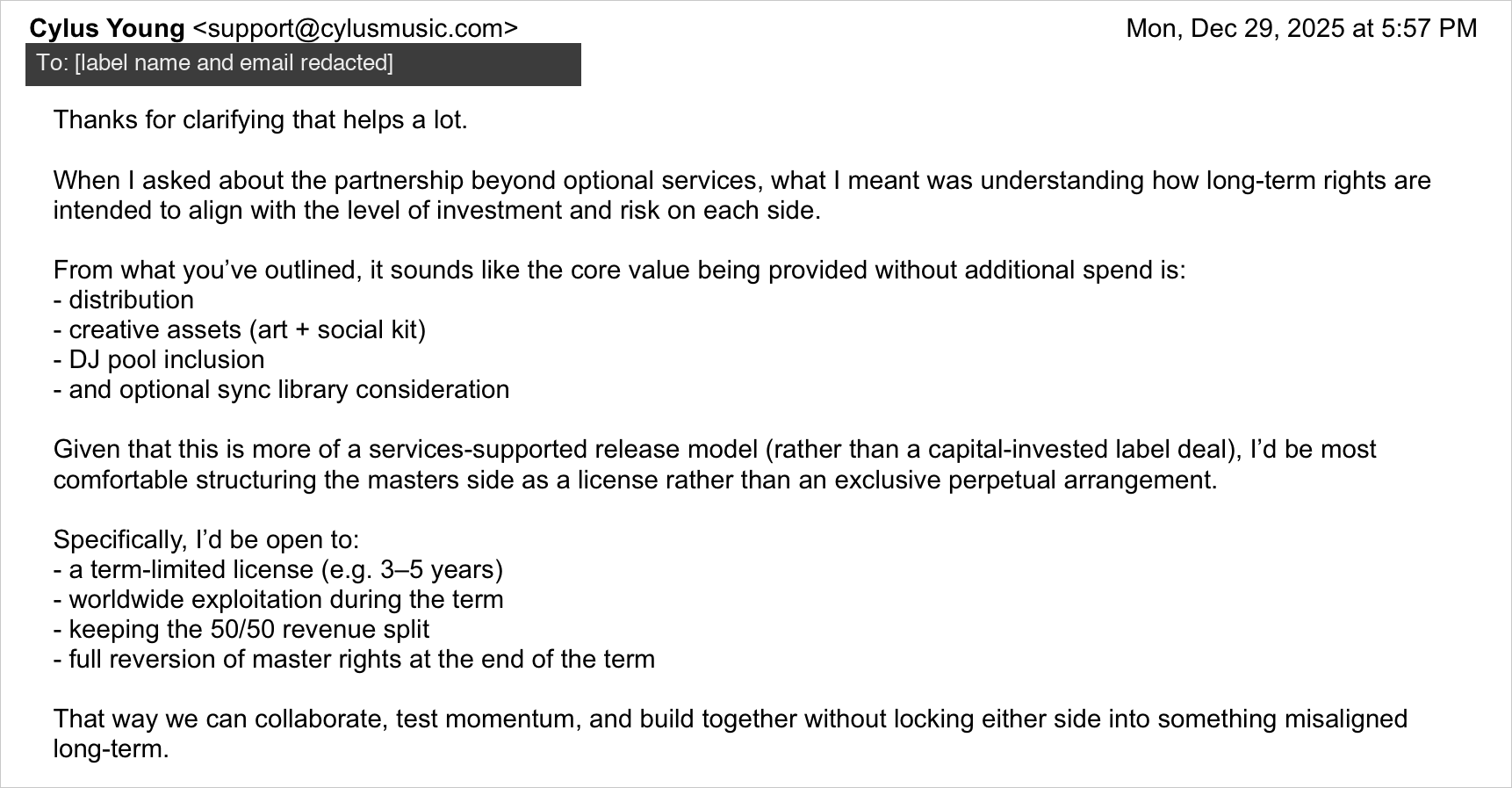
I asked them straight: what value are you providing on the label side without additional spend? The answer was honest; I’ll give them that. Album art, a social media kit, distribution, a DJ pool, and a sync library if I had my IPI. Nothing I couldn’t do with Venice Music and a Canva account.
What I asked for instead
So I sent a counter. A term-limited license instead of an assignment, three to five years. Worldwide during the term. Keep the 50/50 split. Full reversion of the master back to me when the term ends. I said I was open to working together and wanted to test momentum before either of us committed for decades.
That’s not a hardball offer. Symphonic’s breakdown of record label contract types describes exactly this structure as a standard exclusive license: the label gets the rights for a set number of years, then they revert. It’s the most common deal in independent music.
What a two-hour “no” tells you
They declined in under two hours, with no counter of their own. I was a little annoyed, honestly. Also relieved. And I keep coming back to what that speed means: they didn’t want my song for three years. They wanted it forever, or not at all. A label that walks away from a five-year license has told you exactly what your master is worth to them, and it’s more than they were willing to say out loud.
I still wonder sometimes whether I should have taken the exposure. Their DJ pool might have done something. I’ll never know, and that’s the honest version of this story.
What It Cost Me to Release Music Independently
Here’s what the other posts on this topic never include: the invoice. My last single, “Summer Dayyzz,” came out July 24 on my own imprint. I ran the whole campaign myself, and I logged everything.
The spend
Meta ads: $214.54 across a hook test and a pre-save campaign, most of it at five dollars a day. SubmitHub: about 480 credits net after refunds, pitching 46 curators across two batches. Distribution through Venice Music, an annual fee split across everything I release. Art and video I made myself on an iPhone, so zero cash and plenty of hours. Call it somewhere between $600 and $700 out of pocket, not counting my time.
The return
Fifty-one days later the track has 3,100 streams. Five playlist placements and a radio show in Israel from the SubmitHub push. A 5.5% save rate, which is mid-pack for my catalog. Streams per day went up 2.5x after the placements landed, with the ads already off. The playlists were doing more than the ads ever did.
At Spotify’s going rate of a third of a cent to half a cent per stream, that’s somewhere between nine and sixteen dollars in royalties. Roughly twenty cents spent per stream earned. I’m not going to dress that up.
Now run the label version. The promo was an add-on, so I’d have paid for it anyway, kept half of sixteen dollars, and not owned the master. Independently, I paid the same money, and I own the 3,100 streams, the six curator relationships, the ad data, and the song. That’s why the cost per stream doesn’t scare me the way it probably should.
The part nobody tells you
It’s not all upside. Spotify only pays on tracks that reach 1,000 streams in a rolling twelve months; below that line you earn nothing, and a late-2025 survey of independent labels found 85% of them hurt by it.
MIDiA’s 2025 numbers show self-releasing artists lost market share last year even as their stream counts grew, because the money is shifting toward bigger artists and toward merch, live, and brand deals that labels increasingly take a cut of. I wrote about why a million plays still leaves artists broke earlier this year, and the math hasn’t improved. Independence doesn’t fix streaming economics. It just means the small check is yours.
Do You Need a Record Label in 2026? It Depends on One Line
An artist who’s done both
A producer I’ve collaborated with sits at over 100,000 monthly listeners. He’s signed with labels. He now releases independently, on purpose, because in his experience the label releases didn’t work in his favor. He puts his music out through DistroKid, and he won’t be the first to tell you that the platform is nowhere near perfect.
The guy with the audience most small labels would kill for chose to keep his rights and put up with an imperfect distributor instead. If you’re choosing a distributor, expect to trade one set of headaches for another. There’s no clean option, only the one where you own the result.
Splits are negotiable. Ownership isn’t.
I’ll give up revenue for reach; that’s a fair trade when the reach is real. I won’t give up the master forever for a services menu. A split is a price. Perpetuity is a deed. Once you can tell those two apart, most label conversations get very short.
What to Check Before You Sign a Record Label Contract
If an offer lands in your inbox this week, here’s what I’d read before anything else. Most of it comes from the questions I sent that label.
- Term. A license with a fixed end date, three to five years. If the word “perpetual” appears, or the phrase “throughout the universe,” stop reading. Sonicbids calls that language a serious red flag, and so do I.
- Reversion. The master comes back to you when the term ends, automatically. Watch for “until recoupment,” which can mean never.
- Split. 50/50 is fine if they’re pushing the record. Argue about the number after you’ve settled the term and reversion, not before.
- What’s included without spend. Ask it in those words. If the answer is art, a social kit, and distribution, you’re talking to a services company, not a label.
- Add-ons. If pitching and promo are sold separately, price the deal as if they don’t exist. For you, they don’t.
- Publishing. Keep it separate from masters. Never sign both in one onboarding form.
- The tell. Send a reasonable counter. If they decline inside an afternoon with no counter of their own, they’ve told you what your rights are worth. Walk.
I put more of the business side in ten tips for navigating the music business in 2026 if you want the wider picture.
How to Build a Label’s Leverage Without Signing One
The label’s only real product is someone else’s audience. You can get that without a contract.
Collabs are the trade without the perpetuity
My collab tracks beat my solo tracks on the number that matters: saves. They convert listeners at 7 to 17%, against 4 to 6% for songs I put out alone. Sin Nikka, a vocalist I produced for, took a track we made together past 20,000 streams. Neither of us gave up anything. It’s the same deal a label sells: an audience you didn’t build pushing your song, done between two artists who both keep their rights.
Own the list
An email list or a Discord is the one channel no algorithm change can take away. It’s the piece I’ve been slowest to build, and it’s the one I’d start with if I were doing this again. Matthew, a student in my program, hit 10,000 streams on the first track he ever released with no label, just a finished record and a plan. The first 10K is a skills problem, not a label problem. The list is what makes the second 10K cheaper.
Make the release the content
The best-performing ad in my Summer Dayyzz test wasn’t the one people watched longest. It was the one that opened with “I made this song because I didn’t want summer to end.” A real reason, in my own words, on camera. When I hit 1.4 million views in 90 days, the posts that moved music were the ones about the music. Aim for at least 40% of what you post in a release window to be about the song itself.
So, Do You Need a Record Label in 2026?
You need what a label has: an audience on day one. You don’t need to hand over a master forever to get it. Trade splits for reach when the reach is real. Keep the master. Build the rest yourself.
If you’ve got a close track and no idea what happens after it’s finished, that’s what my 12-week coaching program is for: from unfinished ideas to a real release, with the release plan built in. Book a free strategy call at calendly.com/cylus_music and bring the contract if you’ve got one. I’ll read it with you.
Pingback: Meta Andromeda for Musicians: What I Learned at the Invite-Only Agency Summit