I pulled up my actual Meta Ads Manager account before writing this, because I was tired of reading music marketing advice from people who’ve never run a real campaign with their own money. Five campaigns, $1,116 total spend, real streams to measure it against. This is that dashboard, not a hypothetical.
If you’re asking what the benefits of running Meta ads to promote your music actually are, you deserve real numbers, not a list of four generic upsides that could apply to any product. Here’s what I actually spent, what came back, and what I’d tell you to do differently.
What I Actually Spent, and What Came Back
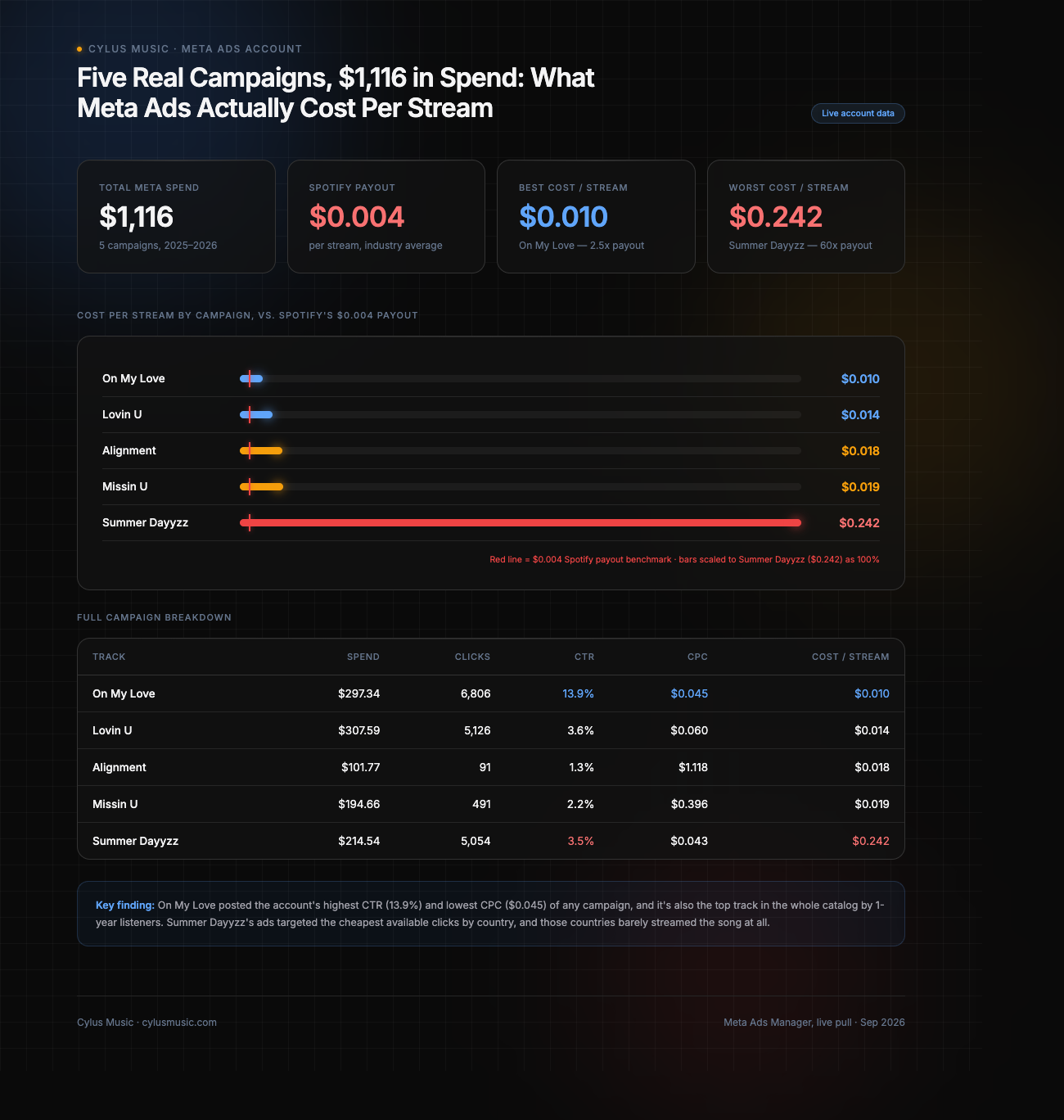
Five tracks, five campaigns, spread across the last year of my Meta ad account. On My Love, Lovin U, Alignment, Missin U, and Summer Dayyzz. Total spend across all five: $1,116.
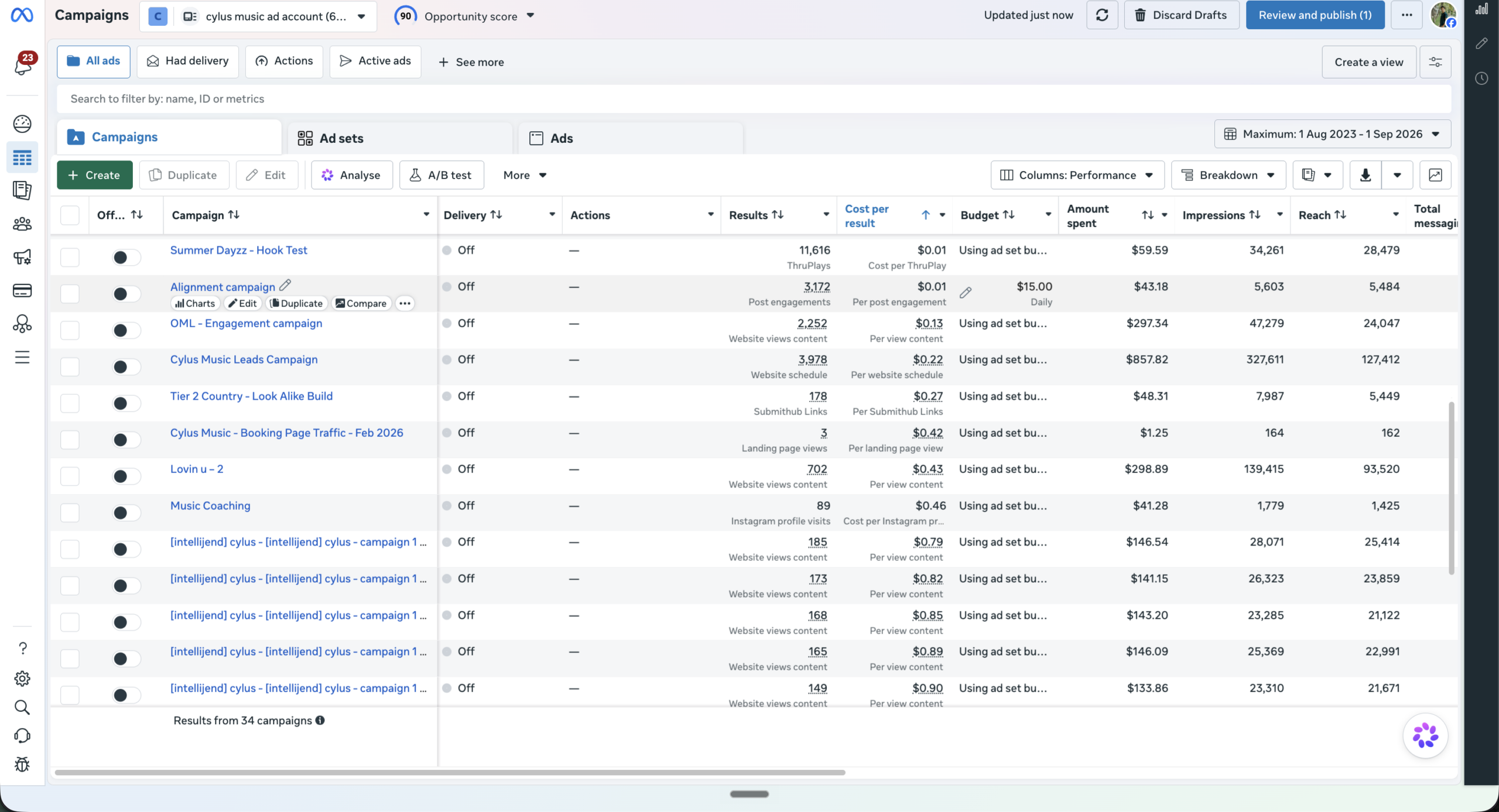
That’s not a mockup built to make a point. Here’s the actual Meta Ads Manager screen those numbers came from, sorted by cost per result across every campaign in the account.
On My Love is the standout. It pulled a 13.9% click-through rate and a $0.045 cost per click, both the best numbers anywhere in my account and well ahead of what’s usually considered an efficient cost per stream for music ads. It’s also the top track in my whole catalog by year-over-year listeners. That’s not a coincidence. The song was already working before I put a dollar behind it.
Summer Dayyzz is the cautionary tale. I honestly thought a $0.20 cost per click was solid when I was running it. Comparing it against my other tracks after the fact, it wasn’t even close to my best result, and Josbon Media (the agency I was paying at the time) ran the near-identical creative on Lovin U with noticeably better numbers. I had a creative I liked, a budget I thought was reasonable, and it still turned into my weakest campaign by a wide margin.
The three middle campaigns, Lovin U, Alignment, and Missin U, all landed close to each other on cost per stream despite being fairly different releases. Lovin U had the widest reach and the most total clicks of anything I ran. Alignment and Missin U spent less and pulled fewer clicks, but the efficiency per stream still came out similar once I compared them side by side. That consistency across three different songs told me more than any single campaign did on its own. The middle of the pack is where most of your campaigns will probably land too, and it’s not a bad place to be as long as you know that going in.
Do Meta Ads for Music Promotion Actually Pay Back in Royalties?
No. Not once, not on any of the five campaigns.
Spotify pays out somewhere between $0.003 and $0.005 per stream on average, depending on the listener’s subscription type and location. Call it $0.004. My best campaign, On My Love, cost $0.010 per stream it generated, which is 2.5 times what Spotify pays back. My worst, Summer Dayyzz, cost $0.242 per stream, which is roughly 60 times the payout. Lovin U, Alignment, and Missin U all landed in the middle, between $0.014 and $0.019 per stream, still 3.5 to 5 times underwater.
This isn’t a Cylus Music problem. It’s math. If you’re spending ad dollars to generate streams and expecting the streams to pay the ad spend back, you’re solving for the wrong variable, and it’s the same trap I wrote about in why a million streams still leaves you broke. Royalties were never going to cover this. Anyone telling you Meta ads for music promotion pay for themselves in streaming revenue alone is either not looking at their own numbers or not showing them to you.
Does Running Meta Ads Actually Help Your Music Career?
Here’s where it gets more interesting than a simple “don’t bother.” The honest case for Meta ads isn’t the direct royalty math. It’s what a concentrated burst of engagement might do for how Spotify’s algorithm treats your track afterward, and it’s what paid reach does for people finding you at all.
I want to be straight with you about this part, because I haven’t proven it myself yet. The theory is that pushing real plays, saves, and listens into a track early can help push it further into Spotify’s recommendation engine, which could compound into organic placement that actually pays off over time. I’ve seen other producers and marketers argue this convincingly. I just haven’t seen it happen in my own account in a way I could point to and say “there, that’s the algorithm push paying off.” That’s the caveat I’d be lying if I left out.
What I have seen work is organic reach doing more of the heavy lifting than the ads themselves, which lines up with how I built momentum hitting 1.4 million views in 90 days without spending a cent on ads to do it. Some producers also report that listeners who find a song through a Meta ad save it at a much higher rate than listeners from a playlist placement, since they’ve already watched a clip of the actual song instead of just landing on a curated list. That’s a real benefit. It’s just not a royalty benefit, and it’s not one I’d bet a coaching student’s whole budget on until it’s proven out further.
What I’d Do Differently If I Started a Campaign Today
Three things, and I’d do all three before spending real money again.
First, I’d pick a song that actually has words in it. Instrumental tracks are harder to test creative against, because you’re stuck describing a feeling instead of hooking someone with a lyric or a vocal moment in the first three seconds.
Second, I’d test five different creatives instead of committing to one. This is the biggest thing Josbon Media got right while they were running my campaigns, and it’s the piece most independent artists skip because testing feels slower than just launching. It isn’t slower. It’s the difference between guessing and knowing, which is the same principle Andrew Southworth uses in his own targeting framework, one I still reference for country tiering on every campaign I run.
Third, I’d test organically first, then pay to push whichever version already performed best on its own. That order matters. You’re not guessing which creative might work, you’re confirming which one already did, then putting money behind a proven winner instead of a hopeful one. Most guidance on Facebook ads for musicians agrees that a minimum viable test needs a real budget and a real window, usually a few hundred dollars over a week or two, not $20 thrown at a single ad set overnight.
The One Non-Negotiable Before You Spend a Dollar on Meta Ads
Have a song you actually believe in. That’s it. That’s the whole non-negotiable.
No amount of targeting precision, creative testing, or budget fixes a track that isn’t there yet. On My Love outperformed everything else in my account not because I ran it smarter, but because it was already the strongest song before the first dollar went toward it. Ads amplify what’s already working. They don’t create a hit out of a song that isn’t one, and no honest breakdown of Meta ads for music promotion should tell you otherwise.
Who Should Run Meta Ads for Music Promotion?
This applies to a few different people. Independent artists deciding whether to run their own campaigns, marketers or managers running ads on behalf of an artist, and anyone just trying to understand what Meta ads for music promotion actually deliver before committing a budget.
If you’re an artist with zero ad experience and a small budget, start smaller than you think you need to. Pick one song, test creative before you spend on reach, and go in expecting to learn more than you earn back. If you’re already running ads for an artist and the numbers look like mine, that’s not a sign to quit. It’s a sign to stop measuring success by streams alone and start measuring it by whether the right people are actually hearing the music.
My honest read after $1,116 and five campaigns: Meta ads are probably still one of the better ways to promote a song in 2026, alongside SubmitHub-style playlist pitching and playing live. Not because the royalty math works. It doesn’t, and it likely won’t. But for building real awareness and putting your song in front of people who wouldn’t have found it otherwise, it’s still one of the more direct levers you have, and sustained, connected marketing consistently outperforms one-off pushes built for a single stunt. The trap is treating streams as the return. Treat it as a way to turn attention into people who actually stick around, and go in knowing the real cost up front.
The Honest Summary
Meta ads for music promotion never paid back in royalties across any of my five campaigns, from 2.5x underwater on my best result to 60x underwater on my worst. The real benefit is awareness and a possible push into Spotify’s algorithm, not direct return, and I haven’t fully proven that second part myself yet. Before you spend anything, make sure the song itself is worth spending on. Ads amplify, they don’t rescue.
If you’re trying to figure out whether your own music is ready for real promotion, or you want a second set of eyes on a campaign before you put money behind it, that’s exactly what a free strategy call is for. Book one here and we’ll look at where you actually stand.
Frequently Asked Questions
- Do Meta ads actually help you get more Spotify streams?
-
Yes, Meta ads can drive real streams by sending targeted listeners to your track. The catch is the cost. Across five real campaigns, every one cost more per stream than Spotify pays back in royalties, so the streams themselves aren’t the return you’re buying. Any awareness or algorithm benefit is separate from, and harder to measure than, the raw stream count.
- How much does it cost to run Facebook or Instagram ads for a song?
-
A meaningful test usually needs a few hundred dollars spread across multiple ad sets over a week or two, not a single small ad set run for a day or two. In this case study, five campaigns ranged from about $100 to over $300 each, with cost per click varying from $0.045 on the best-performing track to over $1 on the weakest.
- Are Meta ads worth it for independent musicians?
-
It depends what you’re measuring. If you’re expecting the ad spend to come back in streaming royalties, no, none of the campaigns in this case study broke even. If you’re using them for awareness, reaching new listeners, or testing which version of a song resonates before pushing it further, they can still be one of the more direct tools available in 2026.
- What’s a good cost per click for a music ad campaign?
-
There’s no universal number, since it depends heavily on the track, the creative, and the targeting. In this account, the best campaign averaged $0.045 per click and the weakest averaged over $1.00 per click, on songs promoted with a similar budget and audience approach. Compare cost per click against your other campaigns, not against a generic industry benchmark, since your own catalog is the most honest baseline you have.
Pingback: Meta Andromeda for Musicians: What Actually Gets Streams