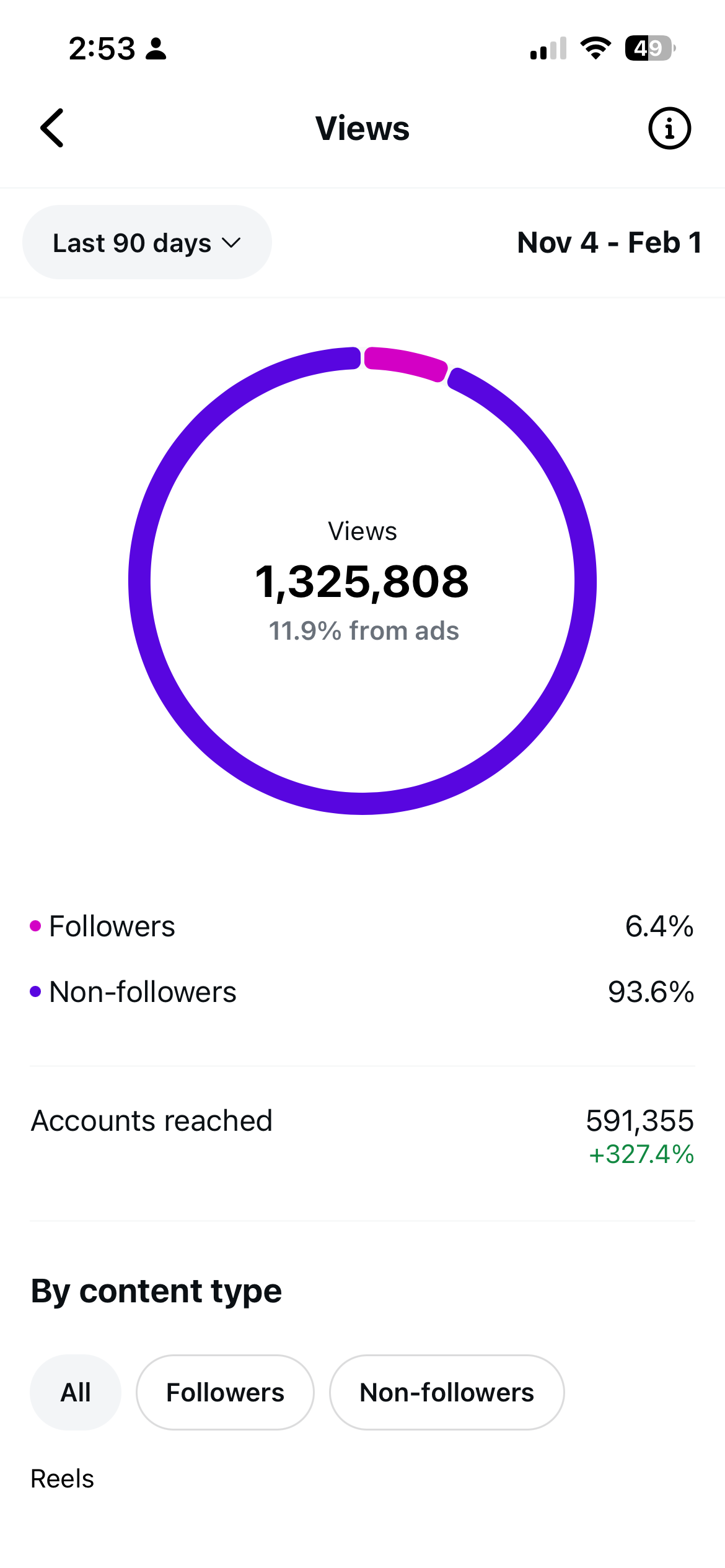
For two years, my videos got 200 to 300 views each. Then, in one 90-day stretch, my content generated over 1.4 million views across Instagram, TikTok, and YouTube. 93.6% of those views came from people who didn’t follow me.
Nothing about my gear changed between those two eras. What changed was finding your niche as a music producer actually means something different than most advice suggests, and my motivation stopped depending on results.
This post is the honest version of both: how I found my lane, and the system that kept me posting through the years when almost nobody watched.
What 1.4 Million Views in 90 Days Actually Looked Like
The receipts first. From November to February, my channels did 1,325,808 views on Instagram, 81,600 on YouTube (up 47% over the previous period), and 10,664 on TikTok.
The strategy underneath
Three things drove it. Instagram’s Trial Reels feature, which tests your content on non-followers before your audience sees it. On-screen text hooks written for one specific person with one specific struggle. And an audience I understood from over 70 calls with the exact producers I make content for.
I broke the full system down in my post on digital marketing for music brands. The industry is moving the same direction: 77% of marketers now say creator content outperforms traditional brand ads.
The proof it converts
Views are only interesting because of what they turn into. A video I made showcasing FabFilter’s Pro-Q 4 pulled over 15,000 organic views. Another reel showcasing Halo 3D Pan, a free plugin that places sounds above, behind, and around the listener, hit 13,500+ likes. Both were simple creator-style videos about tools producers actually care about.
Watch the Halo 3D Pan reel: a simple creator-style video, 13.5K+ likes
That kind of content built brand recognition. Brands started reaching out to me instead of the other way around. Attention compounds when it’s pointed at the right people.
How Do You Find Your Niche as a Music Producer?
There’s a popular line from creators right now: “you are the niche.” I think there’s truth in it eventually. But when you’re starting out, it’s bad advice.
Start with a target audience, not a personality
Early on, nobody knows you, so your personality can’t carry the content yet. What works is a clear target audience. Social media today runs on interest, not follower counts. The algorithm decides who sees your video based on the topic, which means a beginner with the right niche can outperform an established account with a vague one.
My own numbers prove it: 93.6% of my views came from non-followers. The algorithm found my audience for me because the content made it obvious who it was for. That’s also the core of how you get attention as a music producer in the first place.
Pick the thing you can’t get tired of talking about
The guides on niching, like the ones from iMusician and Bandsintown, mostly agree on one thing: your niche sits where your interests intersect with what you’re good at. My version is simpler. Pick something you could talk about for years without getting tired of it, something you genuinely want to master. It can literally be anything.
For me, I loved making videos before I ever produced music. Music production came a few years later, and the two collided the day I got fed up with my job and decided to build content and services around the thing I actually loved. That frustration was the moment I found my lane.
Should you start a new page for your niche?
If you’re worried about spamming friends and family with content they don’t care about, start a fresh page. But honestly, it matters less than people think. The algorithm ships your content to people interested in the topic either way. The new page is for your comfort, not for reach.
How Specific Should Your Niche Be?
More specific than feels comfortable. Not “music content.” Not even “music production content.” One person, with one struggle, that your video names in the first two seconds.
I only got that specific because of those 70+ calls with producers, asking what they were stuck on, what they wanted, what they’d already tried. When you know your ideal viewer’s pain points word for word, you can work backwards into content, and eventually into the product itself.
Every breakout video I’ve had names the viewer’s exact problem in the on-screen text. When someone scrolling feels like the video was made about them, they stop. That’s the entire trick, and it’s unavailable to anyone who hasn’t done the listening first.
Staying Motivated as a Music Producer and Content Creator
I’m in a private creator chat that Meta runs for selected creators. A while back, one creator asked what keeps everyone going, and admitted they were burnt out badly enough that their content was suffering. Still shooting constantly, just unable to bring themselves to edit and post.
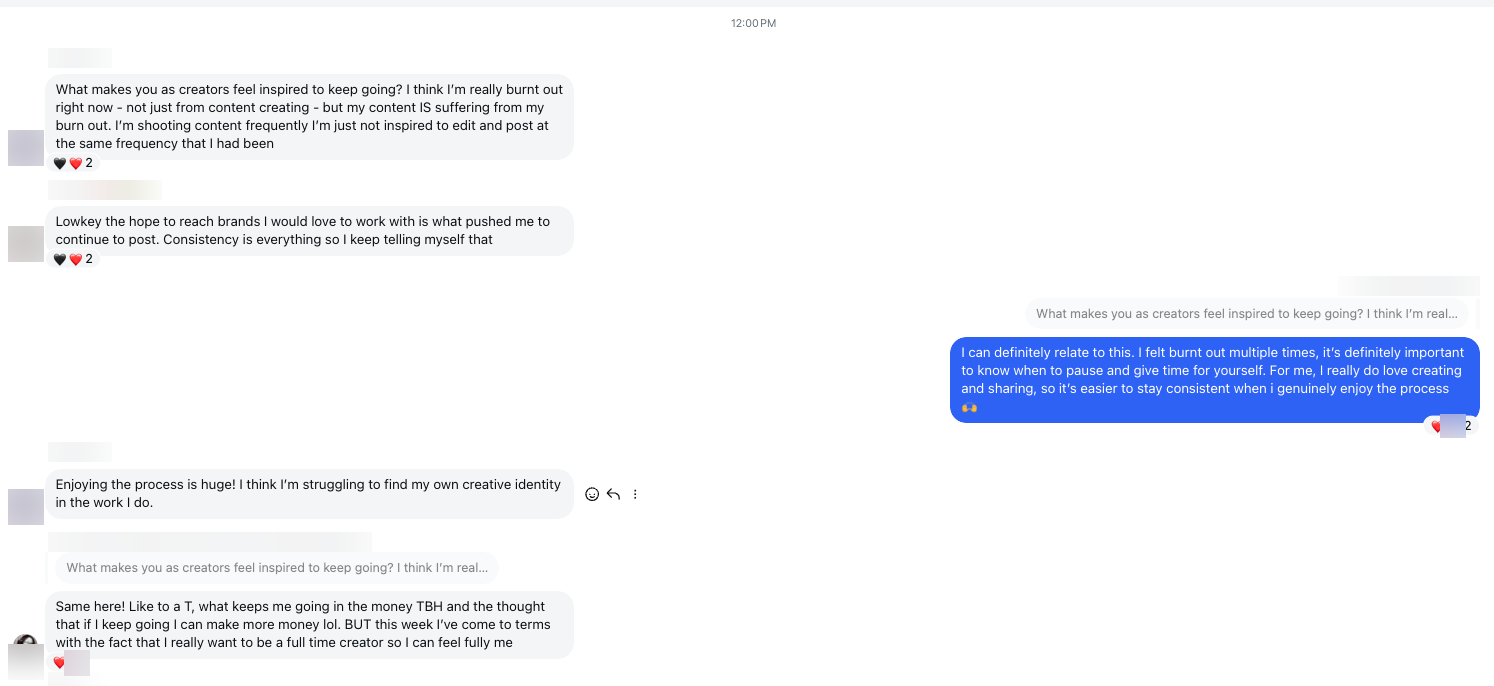
The answers were revealing. One creator said the hope of landing brand deals kept them posting. Another admitted money was the honest motivator, but that same week they’d realized what they actually wanted was to be a full-time creator so they could feel fully themselves. That’s not a small distinction. The research says 52% of creators experience burnout and 37% consider quitting entirely.
Money is fuel, not a compass
My honest take: brand deals and income from content are genuinely motivating, and there’s nothing wrong with wanting them. But if money is the end goal, I don’t think you’ll last as a creator. Create authentically and build a true audience, and the brand deals get easier. Chase the sale directly and everything gets harder. Trust me, I’ve tried that route.
Build a system that survives low-motivation weeks
My reply in that chat was the same thing I’ll tell you: I’ve burnt out multiple times, and what saves me is that I genuinely enjoy the process. Consistency is easy when you love the work and brutal when you don’t. That’s why the niche question and the motivation question are secretly the same question.
The practical layer: I film in batches, then edit or hand off to my editor. I post at least once a week, up to three times when I’m feeling it. Doing everything alone is hard, and even a small team multiplies your output. Structure carries you through the weeks when inspiration doesn’t. My student Rachel found the same thing: the weekly structure of the coaching program kept her creatively energized after months of feeling like she was wasting time in YouTube tutorials.
When burnout hits, take a real detox
When it hits anyway, pause properly. Take a break, go somewhere that gets your mind off content completely. Every time I come back from a real detox, I return with more ideas than I left with. The one caveat: when you’ve got momentum, protect it. Rest before the wall, not after you’ve hit it.
What If Nobody Watches at the Start?
Then you’re exactly where I was for two years. 200 to 300 views per video, over and over.
Two things kept me going. First, even at those numbers, people were finding me. DMs came in saying “wait, you produce music?” and some of those turned into coaching clients. The views were tiny but the business was real, and that proved the model worked before the algorithm ever agreed. If you feel stuck at this stage, it’s usually not a skill problem, and I wrote about the real reason skilled producers stay stuck.
Second, obscurity is a gift. Nobody watching means total freedom to experiment, because you’re not pinned to a niche yet. Use that time to make what you want and find what you can’t stop making.
The video that finally broke through for me said exactly that. It was a reflection on what I’d do differently, with the on-screen text “Music career advice I NEEDED at 20, not 28.” It opened like this:
Nobody is listening yet, and that is a gift. You have freedom right now. Use it to experiment, release badly, and learn fast without pressure.
Watch the reel that broke through: Music career advice I NEEDED at 20, not 28 (14.3K+ likes)
That reel has 14,300+ likes. And the reason it worked is the last lesson: when you’re unknown, nobody wants you telling them what to do. You have no authority yet, and they know it. But share what you would have done differently, from your own perspective, and suddenly people lean in. Perspective beats prescription every time.
My student Matthew lived the same arc in music itself: his first-ever release hit 10,000 streams, not because anyone knew him, but because the work connected. Small numbers compound when the work is honest.
The Niche Is a Decision. The Motivation Is a System.
That’s the whole post in two sentences. Finding your niche as a music producer isn’t a personality test, it’s a decision about who you serve, made specific by actually talking to them. And motivation isn’t a feeling you wait for, it’s a batching schedule, a sustainable pace, real breaks, and work you genuinely enjoy.
The views are a byproduct. Mine took two years to show up, and then they all showed up at once.
If you’re a producer who wants the finishing-tracks side of this handled with the same kind of system, that’s exactly what my 12-week music production coaching program does. Book a free strategy call and we’ll figure out where you’re stuck.
Pingback: What Are the Benefits of Running Meta Ads to Promote Your Music? A $1,116 Case Study