My first three songs on SubmitHub went zero for eleven. Eleven pitches, eleven no’s. My first release was even picking up a little traction on its own, and I figured paying to pitch playlist curators (the people who run playlists) was just how you promote music. I had no idea what I was doing.
Three years later I’ve sent 656 pitches and spent a little over $1,686. So is SubmitHub worth it?
A lot of the SubmitHub reviews you’ll find come from companies selling a competing service. This one comes from the artist side. I lined up every pitch in my SubmitHub history against my Spotify for Artists data, the stats dashboard Spotify gives every artist, to see what Spotify playlist promotion did for me.
Below you’ll find which placements paid off, whether any of it turned into real fans, how long a placement lasts, and what I’d do with the money if I got it back.
What $1,686 on SubmitHub Bought Me
The lifetime numbers
Out of 656 pitches, 150 curators said yes. That’s 88 Spotify playlist adds, 50 Instagram creators who used my song in a Reel, and 12 radio plays, blog write-ups and YouTube features. My SubmitHub approval rate works out to 23%.
SubmitHub says the average approval rate across the whole site sits around 30%, so I landed under that. And my 23% hides how rough the start was.
Why my first songs got zero approvals
Early on I sprayed and prayed. I picked playlists whose names sounded right, never listened to them, and hit send.
Every playlist already has a sound, and the curator’s job is to protect that sound for their listeners. If your track doesn’t match what’s already there, it doesn’t matter how good it is. When your music doesn’t sit neatly in one lane, and mine usually doesn’t, that’s the hardest part of the whole game.
What changed once I listened first
I started listening to every playlist before I pitched it, and sending instrumental versions to playlists built for that feel. I also made more songs with vocals, because that seemed to be what curators wanted.
My own numbers disagree with that last move. The instrumental versions of my songs got approved 39% of the time. The vocal versions of the same songs got approved 22% of the time.
Why 50 Instagram Reels didn’t move my Spotify
In 2024 I tried creators instead of playlists. The logic made sense to me: if a song pops on social media, the streams follow. Fifty creators used my song in their Reels, and some of those videos pulled hundreds of thousands of views.
My Spotify barely moved. A song playing behind someone else’s video is a long way from someone choosing to press play on your song.
Which SubmitHub Placements Were Actually Worth the Money?
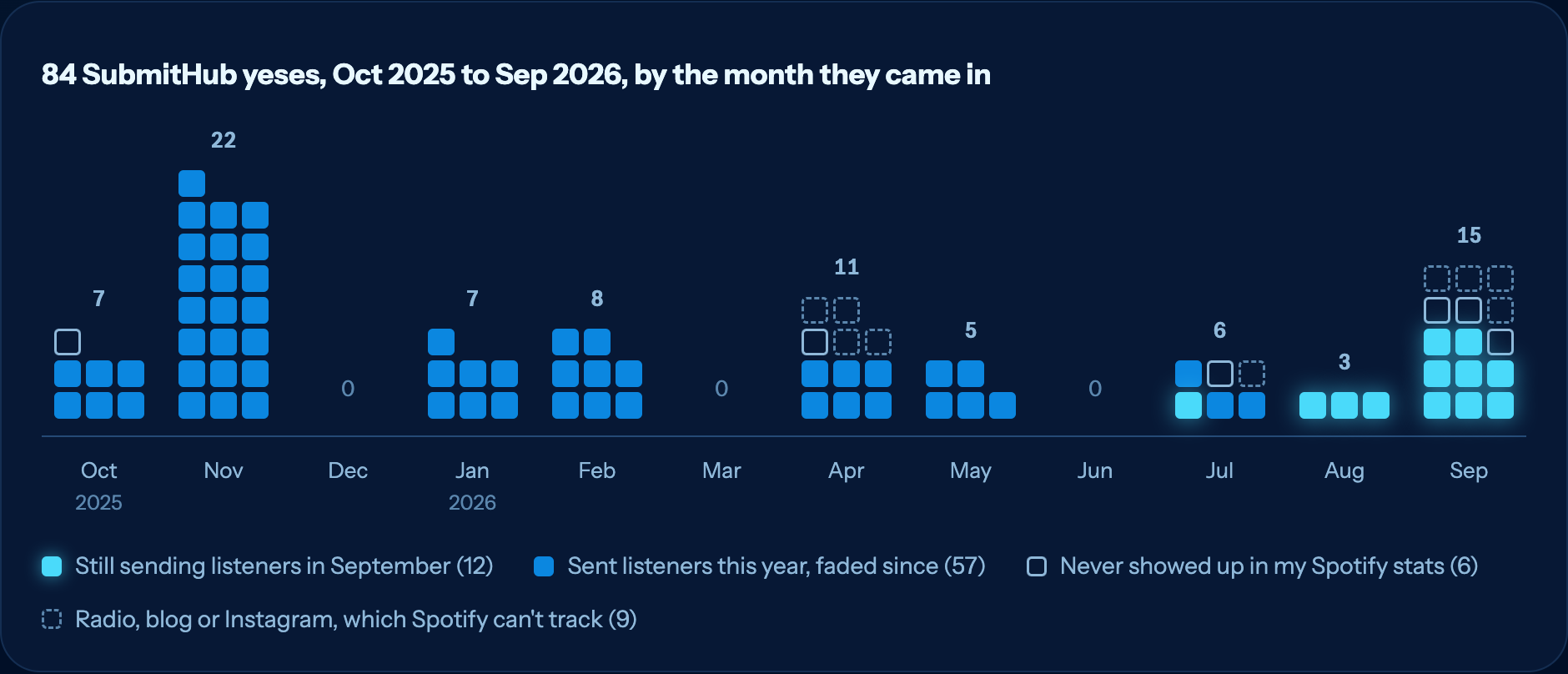
For this part I zoomed in on the last 12 months, October 2025 to September 2026, because that’s where my Spotify data lines up with every pitch. In that stretch I sent 434 pitches, spent $958.75 and got 84 yeses. The playlists behind those yeses sent me 11,011 listeners and 17,541 streams. That works out to about 9 cents a listener.
Eight playlists sent half my listeners
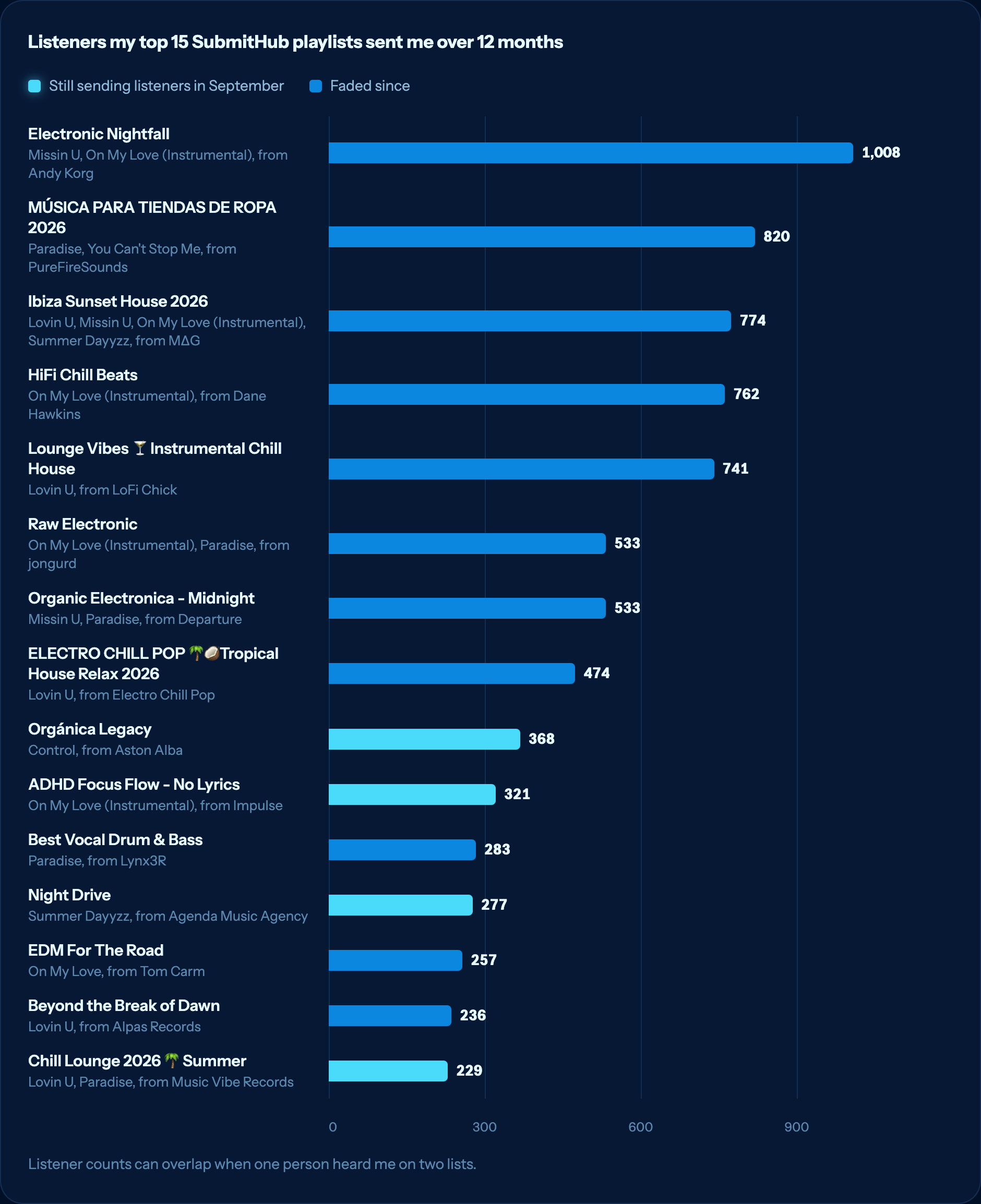
Out of 57 SubmitHub playlists that sent me listeners this year, eight sent more than half of them. The top one, a playlist called Electronic Nightfall, sent 1,008. A Spanish playlist of music for clothing stores, of all things, sent 820 and more streams than any other list I got through SubmitHub.
My two September placements rank ninth and tenth: Orgánica Legacy, and an ADHD focus playlist with “No Lyrics” right in the name. They got there in two to three weeks, the fastest start of any list.
My fastest starters had already told me no
The curator behind Orgánica Legacy, Aston Alba, passed on my song Control in November 2025. Ten months later I pitched the same song again and they took it. Impulse, who runs the ADHD playlist, turned me down four times before their first yes.
A no isn’t permanent. Pitching the same person again doesn’t raise your odds on its own, though. Curators I’d pitched before said yes 19% of the time, and brand new ones said yes 20% of the time. What changed was how well the song fit the playlist.
A yes isn’t the same as a win
One curator said yes to me three times out of three this year. Their playlist sent me 11 listeners in 12 months. Another said yes twice out of eight and sent 820. The approvals felt exactly the same. The results weren’t close.
Rank curators by how many listeners they send you. You can see that in Spotify for Artists under your playlist stats.
Is SubmitHub Worth It for the Spotify Algorithm?
I think SubmitHub is a worthwhile investment for getting traction on the Spotify algorithm, the system that picks songs for Spotify’s own playlists like Discover Weekly and Radio. So does playlist promotion help the Spotify algorithm? My data says it helps less than I expected.
Listeners went up, fans didn’t
During weeks when I was pushing placements, I averaged 171 listeners a day, against 116 when nothing else was going on. New followers barely moved: 1.5 a week against 1.1.
Followers only climbed when I released a new song or ran Meta ads, which are paid ads on Instagram and Facebook.
Same 287 listeners a day, completely different results
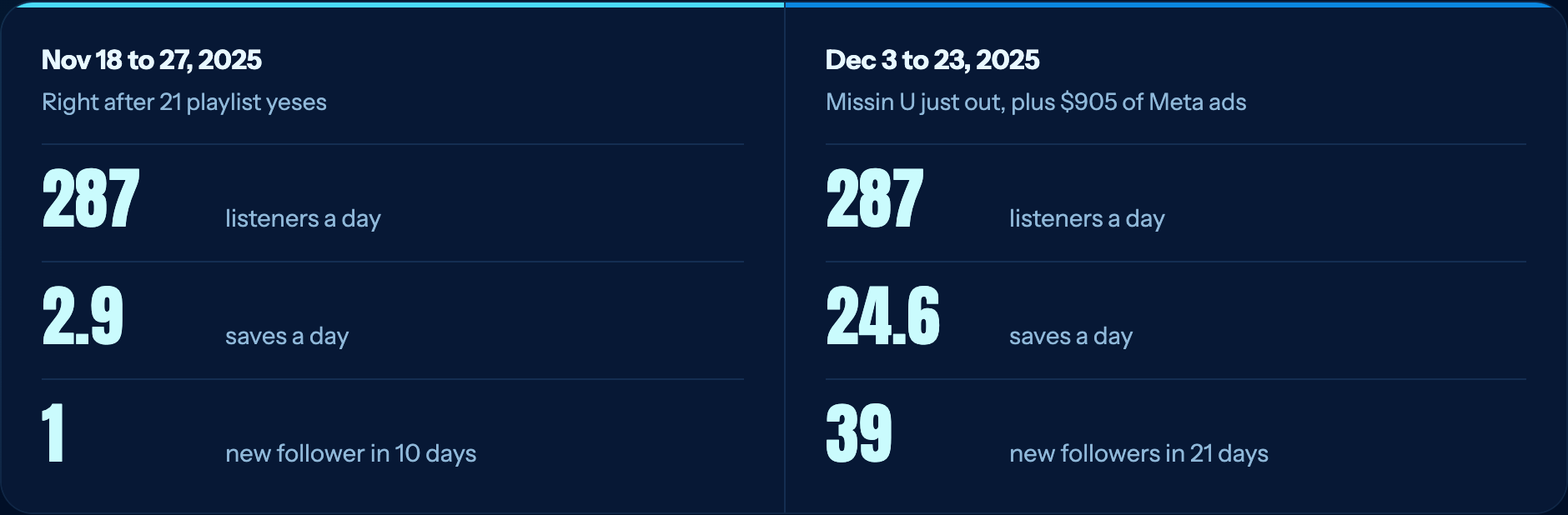
The clearest test happened by accident. From November 18 to 27, 2025, right after 21 playlist yeses, I averaged 287 listeners a day and gained one follower. From December 3 to 23, with a new single out and $905 of Meta ads running, I also averaged 287 listeners a day. That stretch brought 39 new followers.
Spotify also tracks active listeners, the people who chose your music themselves and didn’t just hear it on a playlist (Spotify explains the difference here). After November’s placements my monthly listeners jumped by almost 1,000. My active listeners went from 412 to 403. In December they doubled, from 598 to 1,198.
Even SubmitHub says most people listen to playlists in the background. It’s the same gap I wrote about in why a big stream count doesn’t pay like a fan base.
What happened to Spotify’s own playlists in September
In September my two best placements of the year were live and climbing. Over the same stretch, listeners from Spotify’s own playlists (Radio, Discover Weekly, Mixes and the rest) fell from 348 to 204.
Part of that was my summer releases fading, so it doesn’t prove placements hurt. It does show they didn’t hold the algorithm up. Spotify says its recommendations look at what listeners add to their own playlists and how they listen. You can check where your own plays come from in the source of streams section of Spotify for Artists.
Over the full year, Spotify’s own playlists sent me more streams than all my SubmitHub playlists combined: 29,487 against 17,541, and Radio alone sent 20,843.
So I still think SubmitHub is worth it. It finds the listeners and playlists your music fits. Getting the algorithm to pay attention takes saves and follows, and mine came from releases and ads.
How Long Does a SubmitHub Playlist Placement Last?
About six weeks, then it fades
Most of mine start fading around six weeks and are gone by week twelve. My eight biggest SubmitHub playlists of the year sent me 5,645 listeners. In September, not one of them sent enough to show up in my stats.
The playlists I landed in August were still sending listeners at seven to eight weeks, but shrinking. Comparing two snapshots taken ten days apart, Night Drive fell 35% and Chill House & Lounge fell 59%.
A curator told me straight up
PureFireSounds added my song You Can’t Stop Me to a playlist on November 23, 2025. Six weeks later I pitched it again, and they passed. Their note, translated from Spanish, said the song had been on their playlist until recently, so they couldn’t help right now, but maybe in a month or so they’d add it back.
Curators rotate songs. Music Vibe Records put Lovin U on the same playlist twice, in February and again in May, which only happens if it came off in between.
Why your monthly listeners lag behind
Spotify counts a monthly listener as anyone who played you for at least 30 seconds in the last 28 days. So when a playlist drops you, those people stay in your count for up to four more weeks, then fall off. That’s why the drop always feels sudden.
Mine went from 3,715 on September 1 to 1,992 on September 18 as July and August aged out. I broke down the month my monthly listeners dropped 80% if you want the full story.
Should You Take SubmitHub Curator Feedback Seriously?
Not as a verdict on your art
Here’s the honest truth: I don’t take curator feedback very seriously, and I’d tell you not to either. Everyone hears art differently. One curator will call your track the worst thing they’ve heard all week, and the next will tell you it changed their life.
If you like it, that’s where the value is. Rick Rubin makes the same point: the audience comes last, and making it for yourself first is how you serve them best. The only opinions worth weighing come from people whose taste you actually care about.
Use the patterns to find where you fit
The one thing SubmitHub curator feedback is good for is spotting patterns. When one curator says the vocal is too loud, that’s taste. When several say it across different songs, that tells you where the track fits. It says nothing about whether the song is good.
For me, that pattern pointed my instrumental versions toward focus and relaxing playlists. That’s exactly where one of my two best placements came from.
Is SubmitHub Worth It? What I’d Do With the Money Back
Yes, I’d spend it again. SubmitHub is the fastest way I’ve found to learn which playlists my music belongs on, and those listeners are real people. I’d just spend it differently.
Keep SubmitHub, but make it the smaller budget
I’d only pitch during a release week and cap it at about 100 credits, roughly $72, per song. Every pitch would go to a playlist that already sounds like the song. For me, that means instrumental versions to focus and relaxing playlists, with the curators who’ve already sent me real listeners getting it first.
In that same playlists-plus-ads guide, SubmitHub suggests testing with $100 to $200 before you spend more. That’s a fair ceiling for finding out whether a song fits.
Put more behind ads during a release
The saves and follows came from releases and ads, so that’s where the bigger share goes now. My best ad hook so far is simple: “I made this song because,” then the real reason. I broke down what running Meta ads for my music did in a separate post.
Before any of that, set your release up right on Spotify so the people who click have somewhere good to land.
Skip anything that guarantees streams
If a service promises a guaranteed placement or a set number of streams, walk away. Spotify says paid services that guarantee streams break its rules, and it can remove those streams, hold back royalties or take the track down.
SubmitHub works because curators are free to say no. Paid playlist placement where nobody can say no is a red flag.
The Short Version
A placement buys you listeners, not fans. Rank curators by the listeners they send, and expect every placement to fade in about six weeks, so save your pitches for release weeks.
Is SubmitHub worth it? For finding where your music fits, yes. For building a fan base, pair it with a release and ads.
If you’re a producer who hasn’t gotten a track finished and released yet, promotion is step two. Getting a professional-sounding track out the door is what my 12-week music production coaching program is built for. Book a free strategy call and we’ll see if I can help. And if you want to hear the songs from this post, follow me on Spotify.