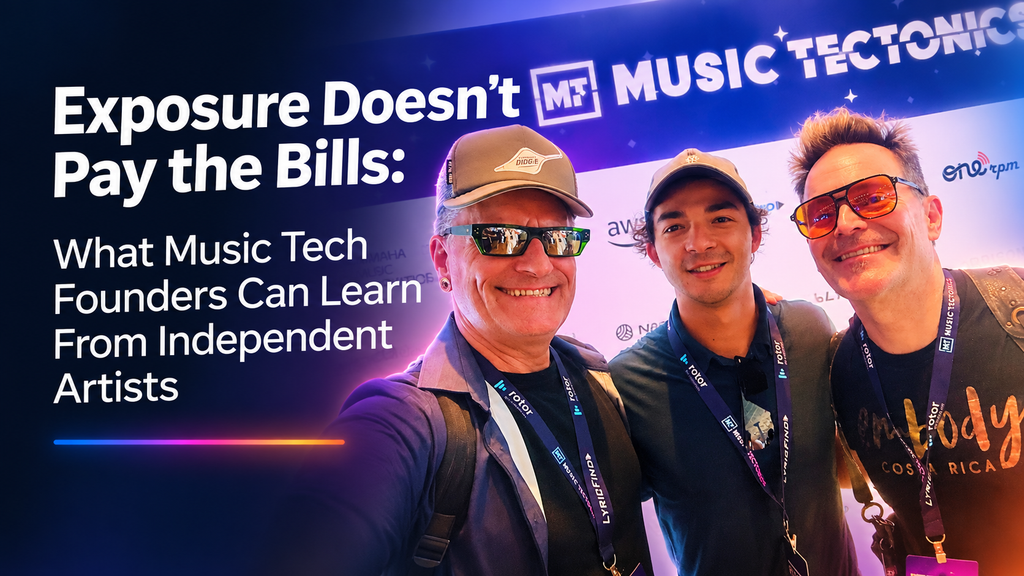
At Music Tectonics in Santa Monica this October, a conference full of music tech founders, I was catching up with my friend, mentor and collaborator DTO when he said something I haven’t stopped thinking about. The most dangerous word in music, he told me, is the E word. Exposure.
Artists aren’t the only ones who fall for it. A lot of music tech founders believe that if they post enough content, success will follow, and I used to believe the same thing. I’ve posted almost 2,000 videos on Instagram alone, plus TikToks and YouTube Shorts, promoting my music, my coaching and other companies’ products. My Instagram picked up about 3.4 million views in the last two years. Those views didn’t pay my bills. Sales did.
Independent artists learn the gap between views and sales the slow way. Founders don’t have to, and at the end of this post I’ll lay out exactly how I’d spend a first $10,000 on creators.
Why Doesn’t More Content Mean More Customers?
What 2,000 videos taught me
Some of those videos were good, and some honestly weren’t my best work. A few took off. I once hit 1.4 million views in a single 90-day stretch, and for a while I treated every spike like a win.
But a view is someone’s thumb pausing on your video for a second. It isn’t a booking or a sale. You can have millions of views and millions of streams, and if none of it turns into dollars, what are you even doing?
Views, streams and followers are vanity metrics
A vanity metric is a number that looks great in a screenshot but doesn’t tell you whether you’re making money. These are easy to grow and fun to post about, and none of them pays rent on its own. The numbers worth watching are duller: how many people paid you, and whether they came back.
Founders are making the same bet
Music tech marketing falls into the same trap with a bigger budget. A startup posts every day, sponsors a few videos, counts the impressions and calls it a good month. I get why, since views show up fast and sales show up slow. But a packed content calendar isn’t a distribution plan, and more volume won’t fix a message that never reaches a buyer.
Exposure Is the Most Dangerous Word in Music
What DTO told me at Music Tectonics
DTO’s point was that so many people in this business promise exposure, and exposure doesn’t pay the bills. Especially not right away.
I’ve paid for exposure myself. I spent about $1,686 on playlist promotion over three years, and what it bought me was listeners, not fans.
Why exposure doesn’t pay, especially not right away
Someone hears your song on a playlist, maybe likes it, and moves on. Unless there’s a next step waiting, like a show to buy a ticket for, that moment disappears. Exposure is a loan against attention you might never collect.
Founders run into the same thing with a creator video that has no link and no code. People see the product, think it looks cool, and scroll on.
What Actually Pays Independent Artists?
You get paid at a sale, not at a view
For artists, the money comes from getting paid for gigs, selling merch, selling tickets to events you promote, and keeping the full royalties on your masters (the original recordings you own). Every one of those is a transaction where someone decides you’re worth paying.
A platform founder on one of the Music Tectonics panels made the same point from the business side. Their company is built around paying creators at the point of transaction and making sure creators know who their customers are. They moved into publishing and rights management after noticing that big hits were being made on their platform while the creators behind them left money on the table.
Own your masters, and read the contract
Owning your masters only helps if the deal around them is clean, and distribution is messy right now. In September, Universal Music Group sued DistroKid in federal court, alleging that DistroKid lets AI-generated “slop” flood streaming services and pull revenue and listeners away from legitimate artists. DistroKid’s formal response isn’t due until December, so none of that is proven.
I don’t know how that case ends. It still feels shady to me, and it’s why I’d tell any artist to read the fine print on fees, add-ons and payouts before signing with anyone. It’s also part of why I don’t think artists need a record label anymore.
My own direct-to-consumer income
Direct-to-consumer just means selling straight to the person who uses what you make, with nobody in the middle. For me, that’s teaching music production online, making paid content for music brands, and consulting, which covers mix and master feedback, track and project reviews, and social media help.
All of it starts with a real conversation before any money moves. Views can open that conversation, but they don’t close it.
Why Is Direct-to-Consumer Harder Than Music Tech Founders Think?
An audience isn’t a customer list
Founders tend to read big audience numbers as demand. Cherie Hu at Water & Music spoke with more than 30 music tech founders and reviewed nearly as many pitch decks. She found that many size their market by stacking huge top-down figures, like the total number of music listeners, instead of looking at what real users do, and she says that leads to serious overestimates.
I see the same gap in my own numbers. An audience is everyone who’s seen you once. Customers are the much smaller group who trust you enough to pay.
Producers buy from people they already trust
Marketing to music producers is hard because they’re skeptical buyers who’ve seen countless plugin ads promise a pro mix in one click. What moves them is watching someone they already trust use the tool on a real track. That’s why most music brand content doesn’t convert: it’s built like an ad when it should feel like a friend’s recommendation.
What Making Content With FabFilter Taught Me About Brand Deals
Show the feature, not the logo
My best brand video so far is a reel about FabFilter’s Pro-Q 4, an EQ plugin (a tool that shapes the tone of each sound in a mix). It was a gifted collaboration, not a paid one. I didn’t read a script about how great the company is. I showed one feature: it can show you exactly where two sounds are clashing, so you can fix the overlap instead of guessing.
That reel has 17,007 views on Instagram, reached 12,722 accounts, and picked up 339 saves and 149 shares. The saves matter most to me. A save means a producer wanted it for their next session, which is about as close to buying intent as Instagram gets.
17,007 views, and nobody knows what it sold
I never saw how many copies of Pro-Q 4 that video sold. There was no discount code and no tracking link, so if FabFilter knows, the number never came back to me. Even my best brand video is measured in views, the same vanity metric I’ve spent this whole post knocking.
That’s normal, and it’s a problem. An eMarketer report found that about half of marketers judge influencer campaigns by reach, while 44% track sales, according to Tubefilter’s coverage of the report. The same article cites a Harris Poll survey in which 85% of U.S. creators said brands give them no feedback on how their campaigns are evaluated.
The fix: a code or a link on every creator video
Give every creator a unique discount code or tracking link, then share the results with them afterward. It costs almost nothing. You’ll learn which creators actually move product, and they’ll learn what to make more of.
How Should Music Tech Founders Spend Their First $10K on Creators?
Hire the best creators, not the best producers
The best producer in the world can be terrible on camera. You want people who can hold attention and explain a feature clearly in 30 seconds, so look at their saves and comments before their gear list or follower count.
Pay four creators $2,000 for three or four videos each
Four creators at about $2,000 each is $8,000, and the last $2,000 goes to ads. For that money, ask each creator for three or four videos instead of one, so you have different hooks to test, and make sure every video shows your best feature doing something useful.
The extra videos matter because ads wear out. Agentio looked at $130 million in ad spend and found that winning ads fatigued after about 36 days on average, as Net Influencer reported.
Test on Trial Reels before your followers see it
Instagram’s Trial Reels show a video to non-followers first. The creator checks how it did, then shares it with everyone, or lets Instagram share it automatically if it performs well within 72 hours. That’s a free A/B test, meaning you try two versions and keep the one that wins. Have each creator post their versions as trials and push only the winners to their full audience.
License the videos and run the winners as ads
Before anyone films, get the license in writing so you can run the creator’s face and video as ads. Partnership ads, which run from the creator’s account with your brand attached, tend to beat the same content posted from a brand page.
Meta’s own October white paper reported a 45% lower median cost per extra sale when at least 30% of a campaign’s ads were partnership ads. That figure comes from 20 lift studies (tests comparing people who saw the ads with people who didn’t) in Europe, the Middle East and Africa. Since those are Meta’s numbers, I’d treat them as the high end. Agentio’s report found a smaller edge, about 5% cheaper per sale than the same creator content run from a brand account.
Put your $2,000 behind whatever won organically. If you’ve never run Meta ads, I broke down how Meta’s ad system picks a winner in another post.
Judge it on sales, not views
At the end, count the codes used, sales and signups for each creator. Keep the ones who sold and replace the ones who only got views.
The Short Version
Artists get paid at a transaction, and music tech founders should judge creator deals the same way, with codes, links and sales instead of view counts. For a first $10,000, that means four creators who can teach, three or four videos each, Trial Reels to find the winners, and ads behind the ones that work.
If you’re building a music tech product and want videos that show the feature and count the sales, here’s how I work with brands. And if we met at Music Tectonics, I’d love to hear what you’re testing next.
Frequently Asked Questions
- Why doesn’t posting more content lead to more sales for music tech companies?
-
A view isn’t a purchase. Views, streams and followers are vanity metrics: easy to grow, but they don’t tell you whether anyone paid. Without a next step like a discount code, a tracking link or an offer, the attention from a video just disappears.
- How should a music tech startup spend its first $10,000 on creators?
-
Pay four creators who can teach about $2,000 each for three or four videos apiece, test those videos as Instagram Trial Reels, license the winners, and put the remaining $2,000 behind them as partnership ads. Judge each creator on codes used and sales, not views.
- What are partnership ads?
-
Ads that run from a creator’s account with your brand attached. Meta’s October 2026 white paper reported a 45% lower median cost per extra sale when at least 30% of a campaign’s ads were partnership ads, though those are Meta’s own figures. An independent Agentio report found a smaller edge of about 5%.
- How can a brand tell whether a creator video sold anything?
-
Give every creator a unique discount code or tracking link, and share the results with them afterward. Many brands skip this. An eMarketer report found about half of marketers judge influencer campaigns by reach, while 44% track sales.